A five-metric framework for measuring whether AI is actually deflecting demand, lowering total service cost, and improving the customer experience.
A MetricNet White Paper by Jeff Rumburg, Co-founder & Managing Partner, MetricNet · 2026
Executive Summary
Contact centers of all types, including service, sales, claims, technical support, and collections, are moving rapidly to adopt, deploy, and mature artificial intelligence. Virtual agents, agent copilots, customer self-service, workflow automation, and intelligent routing are becoming standard elements of the AI-enabled operating model. Yet adoption and results vary widely. Among AI adopters, some have achieved exceptional results while others have little to show for their efforts. The key differentiator is a disciplined approach to AI-specific performance metrics and performance targets.
Many contact centers still rely on metrics and scorecards designed for human operations. Those measures remain useful, but they cannot by themselves demonstrate whether AI is resolving more demand without an agent, lowering total service cost, improving resolution, or protecting and improving the customer experience. Without AI-enablement metrics, leaders can report AI activity but cannot demonstrate AI value.
Without AI-enablement metrics, leaders can report AI activity but cannot demonstrate AI value.
A simple yet powerful measurement framework starts with five crucial metrics: contact deflection rate, agentless resolution rate, cost per contact, first contact resolution rate, and customer satisfaction. Every contact center should track all five of these metrics, regardless of where it falls on the spectrum of AI maturity. Together, they provide a consistent basis for benchmarking your AI-enabled contact center against a non-AI baseline.
01 Metric Definitions
It is helpful to start by defining the metrics that will be discussed throughout this white paper. They are as follows:
Contact deflection rate: the percentage of contacts that originate in an AI-enabled channel, including voicebots, chatbots, and AI-supported self-service, rather than being routed directly to an agent.
Agentless resolution rate: the percentage of contacts completely resolved without agent intervention. A contact should count as agentless only when the customer’s need is completed, not merely contained or abandoned in an agentless channel.
Cost per contact: the fully loaded cost of the contact center divided by all contacts handled, including contacts routed to or resolved in agentless channels.
First contact resolution: the percentage of contacts resolved on the first interaction, regardless of whether resolution occurs in an agentless AI channel or with a live agent.
Customer satisfaction: the percentage of customers who report being satisfied or very satisfied with their contact center interaction, regardless of channel or whether resolution was agentless or agent assisted.
The full white paper adds the benchmark itself — three operating profiles across all six metrics — the AI case-mix effect, an illustrative 24-month evolution, and guidance on turning these measures into a management system for AI value.
To continue reading, you must become a member.
Membership is free and sign-up only takes a moment. Click the sign-up button below, complete the short form, and the full white paper — including every figure and a downloadable PDF — opens immediately.
A five-metric framework for measuring whether AI is actually deflecting demand, lowering total service cost, and improving the customer experience.
A MetricNet White Paper by Jeff Rumburg, Co-founder & Managing Partner, MetricNet · 2026
Executive Summary
Contact centers of all types, including service, sales, claims, technical support, and collections, are moving rapidly to adopt, deploy, and mature artificial intelligence. Virtual agents, agent copilots, customer self-service, workflow automation, and intelligent routing are becoming standard elements of the AI-enabled operating model. Yet adoption and results vary widely. Among AI adopters, some have achieved exceptional results while others have little to show for their efforts. The key differentiator is a disciplined approach to AI-specific performance metrics and performance targets.
Many contact centers still rely on metrics and scorecards designed for human operations. Those measures remain useful, but they cannot by themselves demonstrate whether AI is resolving more demand without an agent, lowering total service cost, improving resolution, or protecting and improving the customer experience. Without AI-enablement metrics, leaders can report AI activity but cannot demonstrate AI value.
Without AI-enablement metrics, leaders can report AI activity but cannot demonstrate AI value.
A simple yet powerful measurement framework starts with five crucial metrics: contact deflection rate, agentless resolution rate, cost per contact, first contact resolution rate, and customer satisfaction. Every contact center should track all five of these metrics, regardless of where it falls on the spectrum of AI maturity. Together, they provide a consistent basis for benchmarking your AI-enabled contact center against a non-AI baseline.
But benchmarking is only the starting point. Contact centers must also track and trend each metric over time. The trend reveals whether AI is producing sustained operational, financial, and customer outcomes rather than a temporary improvement or isolated result. The objective is straightforward: track the right metrics, create a baseline, establish performance targets, monitor the direction and rate of change, and demonstrate the value created by AI.
01 Metric Definitions
It is helpful to start by defining the metrics that will be discussed throughout this white paper. They are as follows:
Contact deflection rate: the percentage of contacts that originate in an AI-enabled channel, including voicebots, chatbots, and AI-supported self-service, rather than being routed directly to an agent.
Agentless resolution rate: the percentage of contacts completely resolved without agent intervention. A contact should count as agentless only when the customer’s need is completed, not merely contained or abandoned in an agentless channel.
Average handle time: the average time required to handle a contact. For agent-handled contacts this includes talk time, hold time, and after-contact work time.
Cost per contact: the fully loaded cost of the contact center divided by all contacts handled, including contacts routed to or resolved in agentless channels.
First contact resolution: the percentage of contacts resolved on the first interaction, regardless of whether resolution occurs in an agentless AI channel or with a live agent.
Customer satisfaction: the percentage of customers who report being satisfied or very satisfied with their contact center interaction, regardless of channel or whether resolution was agentless or agent assisted.
02 The Measurement Gap
The pace of AI deployment has created a widening gap between technology adoption and performance management. Organizations are investing in new capabilities, but many continue to evaluate the contact center with measures built around queues, staffing, and agent productivity. Those measures explain how human-assisted work is performed, but reveal little about the workload AI is absorbing, the outcomes it produces, or how the economics of the entire contact center are changing.
This gap makes it difficult to distinguish genuine improvement from a shift in workload. A reduction in agent-handled contacts may reflect successful automation, but it may also be the result of abandonment, channel switching, or unresolved demand. A lower cost in one channel may not reduce total service cost across all channels. Strong deflection or containment may be offset by lower first contact resolution or customer satisfaction. AI performance must therefore be evaluated holistically through a balanced set of workload, economic, and customer measures.
The first requirement is a measurement discipline. Every contact center should adopt the core AI-enablement metrics, apply them consistently, and establish a pre-AI baseline. The baseline is the reference point against which subsequent changes can be evaluated. Without it, leaders may know that performance changed after deployment, but cannot quantify the magnitude, pace, or durability of that change.
03 The Benchmark Framework
MetricNet typically measures more than 40 metrics in a peer group contact center benchmark. But measuring and monitoring an AI-enabled contact center does not require that full breadth of metrics. Five key performance indicators are sufficient for evaluating progress over time: contact deflection rate, agentless resolution rate, cost per contact, first contact resolution rate (FCR), and customer satisfaction (CSAT). This narrower scope highlights the metrics most directly affected by AI deployment. Deflection and agentless resolution capture workload impact, cost per contact captures economic impact, and FCR and CSAT capture the customer impact.
The benchmark compares three operating profiles across North American contact centers: non-AI-enabled contact centers, average performing AI-enabled contact centers, and top-quartile performing AI contact centers. Average handle time (AHT) is included as a supporting metric because it demonstrates how the complexity of agent-handled work changes as AI matures.
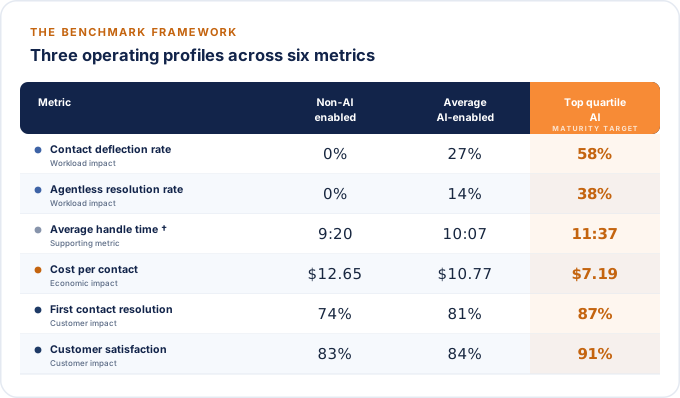
Figure 1. The AI contact center benchmark. Three North American operating profiles, non-AI-enabled, average AI-enabled, and top-quartile AI, compared across the five core metrics plus average handle time. The top-quartile column is the maturity target. (Average handle time is a supporting metric: it rises with AI maturity as a case-mix effect, even as cost per contact falls.)
04 The Benchmark Sample
The benchmark results consolidate data from North American contact centers across multiple vertical markets. Industry mix matters because contact types, transaction complexity, regulatory requirements, channel adoption, and labor economics differ by sector. The data should therefore be viewed as a broad reference point, with statistically meaningful trends, rather than rigid targets for every contact center. A true peer group benchmark would normalize the data by vertical sector, scope of services offered, volume of contacts handled, average complexity of contacts, and geography.
Average handle time illustrates why context matters. AHT can vary substantially across vertical markets, and that variation directly affects cost per contact. Financial services, healthcare, claims, technical support, and other complex environments will have longer handle times than retail, reservations, or routine customer service. Interpreting any benchmark should therefore separate the effect of AI maturity from the effect of the underlying complexity and mix of work.
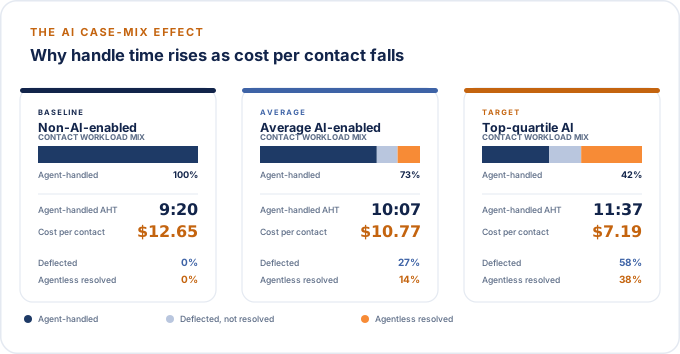
Figure 2. The AI case-mix effect. As AI absorbs the simplest, shortest contacts through deflection and agentless resolution, the agent-handled share shrinks but grows more complex, so average handle time rises even as total cost per contact, including agentless resolutions, falls.
AHT also tends to rise as AI maturity increases. This is a case-mix effect, not necessarily a sign of declining productivity. The contacts best suited for deflection and agentless resolution are often the simplest and shortest. As AI absorbs more of that work, agents receive a smaller but more complex set of contacts involving exceptions, judgment, empathy, negotiation, or multiple systems. The average agent-handled contact therefore takes longer to resolve, even as total cost per contact, including agentless resolutions, decreases and customer outcomes improve.
As AI absorbs simpler contacts, the remaining agent workload becomes more complex. AHT rises while total cost per contact decreases.
05 What the Benchmark Reveals
The data shows that AI maturity matters as much as AI adoption. Average performing AI-enabled contact centers outperform non-AI-enabled centers on four of the five metrics, while just barely outperforming on CSAT. Top-quartile AI contact centers achieve markedly stronger results across every metric. The gap between average and top-quartile performance indicates that deployment alone does not produce the full value of AI. Value grows as contact centers improve automation quality, redesign workflows, integrate AI across channels, and manage performance against explicit targets.
Workload impact expands sharply in the top quartile. Average performing AI-enabled centers deflect 27% of contacts and resolve 14% without an agent. Top-quartile performing centers reach 58% deflection and 38% agentless resolution. Both measures more than double between the average and top-quartile performers. The gap between deflection and agentless resolution is also significant: not every deflected contact becomes a verified agentless resolution. Contact centers should measure and track these workload metrics separately rather than treating them as interchangeable.
The economic impact is substantial. Average performing AI contact centers report a cost per contact of $10.77, approximately 15% below the non-AI benchmark of $12.65. Top-quartile centers reduce cost per contact to just $7.19, approximately 43% below non-AI-enabled centers and 33% below the average AI contact center. The largest economic gains appear after AI moves beyond isolated use cases and becomes an embedded part of the operating model.
Customer outcomes also show significant improvement when migrating from average to top-quartile performance. FCR rises from 74% in non-AI-enabled centers to 81% in average AI-enabled centers and 87% in the top quartile. CSAT moves only one percentage point, from 83% to 84%, at the average AI contact center, but reaches 91% in the top quartile. AI adoption therefore does not automatically improve the customer experience. Average AI maturity captures operational and economic benefits first; top-quartile centers combine those gains with materially better contact resolution and customer satisfaction.
06 Track Performance Over Time
A benchmark is a reference point, not proof of progress. Point-in-time comparisons show how a contact center performs relative to peers. Trend data shows whether the operation is improving, how quickly it is improving, and whether the change can be sustained.
Each metric should be reported as a time series anchored to a clear pre-AI baseline. Reporting should show performance levels before deployment, the timing of major AI releases, and the trajectory after implementation. Leaders should be able to see whether deflection and agentless resolution are increasing, whether cost per contact is decreasing, and whether FCR and CSAT are also improving.
The measures should be reviewed together. Favorable movement in one metric does not establish success if other metrics deteriorate. Higher deflection and agentless resolution create value only when customers achieve the outcomes they need. Lower cost per contact matters only when it does not come at the expense of resolution or customer satisfaction.
Performance targets should reflect both peer performance and the contact center’s starting point. The non-AI benchmark establishes the baseline, the average AI benchmark defines an initial performance threshold, and the top-quartile benchmark provides a maturity target. This turns benchmarking from a periodic comparison into a management system for AI value realization.
07 Illustrative 24-Month AI Evolution
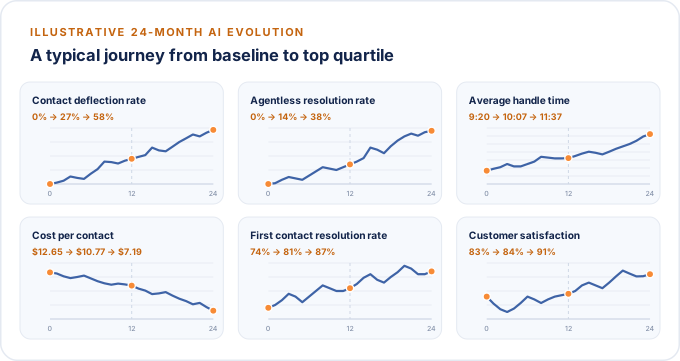
The following charts illustrate a typical 24-month journey from the non-AI benchmark at Month 0, to the average AI-enabled benchmark at Month 12, and the top-quartile AI benchmark at Month 24. The monthly values fluctuate based on several factors including the speed of implementation, seasonality, workflow changes, and ongoing model tuning.
Figure 3. An illustrative 24-month journey for all five core metrics plus average handle time: from the non-AI baseline at Month 0, to average AI maturity at Month 12, to the top quartile at Month 24.
Reading the six trajectories together shows why no single metric tells the whole story:
Contact deflection typically builds as use cases and channel coverage expand.
Verified agentless resolution may grow more slowly than deflection, because not every deflected contact is fully resolved by AI.
AHT increases as AI absorbs simpler contacts, so the remaining agent-handled work is more complex.
Cost per contact can decrease unevenly as fixed costs, adoption, and workflow redesign catch up with automation.
FCR sometimes decreases during early implementation before improving, as routing, knowledge, and automation quality mature.
CSAT may remain flat or soften initially, then improve as the AI experience becomes more reliable and complete.
08 Demonstrating the Value of AI
AI value should be visible in the performance reporting of the contact center. The case begins with a reliable baseline and continues with consistent measurement after deployment. The organization should connect changes in the five core AI metrics to specific phases of AI deployment and show whether those changes persist.
This approach creates accountability. It gives executives a common view of workload, financial impact, and customer outcomes. It also gives contact centers a practical way to identify where AI is delivering value, where performance has stalled, and where additional changes may be required.
The standard for success is measurable improvement, not the presence of AI technology.
Organizations that adopt the right metrics, set targets, track trends, and compare results with relevant benchmarks can distinguish deployment from performance, and activity from value.
09 Conclusion
Contact centers are racing toward AI enablement, but measurement practices have not kept pace. The remedy is a consistent scorecard built around contact deflection rate, agentless resolution rate, cost per contact, first contact resolution rate, and customer satisfaction. These metrics should be benchmarked against a non-AI baseline, and then tracked over time.
The benchmark data shows a clear progression. Average AI-enabled centers begin to capture workload and cost benefits, while top-quartile AI centers extend those gains to resolution and customer satisfaction. Contact centers that measure the five KPIs as an integrated system will be better positioned to manage AI maturity, close the gap to top-quartile performance, and demonstrate sustained operational, financial, and customer value.
About the Author
Jeff Rumburg — Co-founder & Managing Partner, MetricNet
Jeff Rumburg is a co-founder and Managing Partner of MetricNet, where he is responsible for global strategy, product development, and financial operations. A leading expert in benchmarking and re-engineering, he has been retained as a benchmarking and contact center expert by many of the world’s best-known companies and was honored with the Ron Muns Lifetime Achievement Award for his contributions to the IT Service and Support industry.
Prior to co-founding MetricNet, Rumburg was president and founder of The Verity Group and held executive positions at Gartner and META Group. His education includes an M.B.A. from Harvard Business School, an M.S. magna cum laude in Operations Research from Stanford University, and a B.S. magna cum laude in Mechanical Engineering. He is the author of A Hands-On Guide to Competitive Benchmarking: The Path to Continuous Quality and Productivity Improvement and has taught graduate-level engineering and business courses.