1.
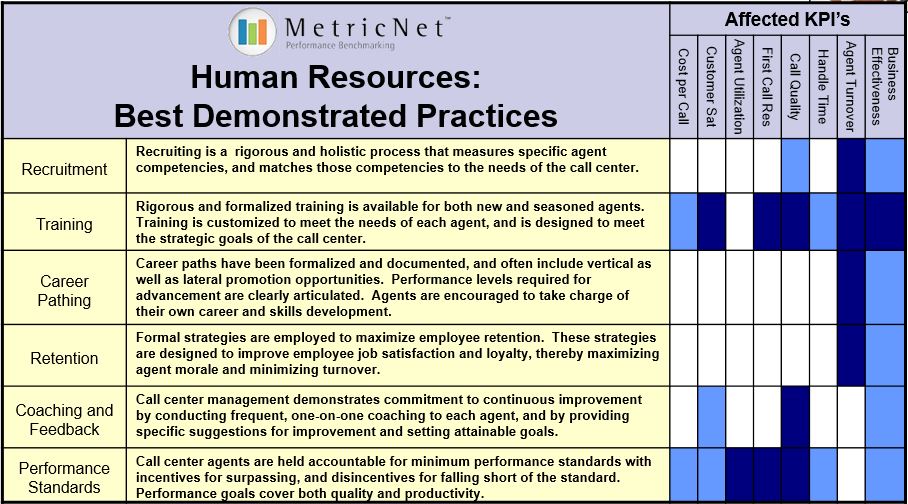
Recruiting is a rigorous and holistic process that measures specific agent competencies, and matches those competencies to the needs of the call center. This best practice has a minor influence on call quality and business effectiveness. It has a strong influence on agent turnover and little to no influence on the other affected KPIs.
2.
Rigorous and formalized training is available for both new and seasoned agents. Training is customized to meet the needs of each agent, and is designed to meet the strategic goals of the call center. This best practices has a strong influence on customer satisfaction, first call resolution rate, call quality, agent turnover and business effectiveness. It has a minor influence on cost per call and hancle time and little to no influence on agent utilization.
3.
Career paths have been formalized and documented, and often include vertical as well as lateral promotion opportunities. Performance levels required for advancement are clearly articulated. Agents are encouraged to take charge of their own career and skills development. Career Pathing has a strong influence on agent turnover, a minor influence on business effectiveness and little to no influence on any other affected KPIs.
4. Formal strategies are employed to maximize
employee retention. These strategies are designed to improve employee job satisfaction and loyalty, thereby maximizing agent morale and minimizing turnover. This best practice has a strong influence on agent turnover, a minor influence on business effectiveness and little to no influence on the other affected KPIs.
5.
Coaching and Feedback - Call center management demonstrates commitment to
continuous improvement by conducting frequent, one-on-one coaching to each agent, and by providing specific suggestions for improvement and setting attainable goals. Coaching and feedback strongly influences call quality. It has a minor influence on customer satisfaction and business effectiveness. It has little to no influence on the other affected KPIs.
6.
Performance Standards - Call center agents are held accountable for minimum performance standards with incentives for surpassing, and disincentives for falling short of the standard. Performance goals cover both quality and productivity. This best practice has a strong influence on customer satisfaction, agent utilization and first call resolution. It has a minor influence on cost per call, customer satisfaction, handle time and business effectiveness and little to no influence on agent turnover.
Please join us next month for Best Practices in Call Handling Process.
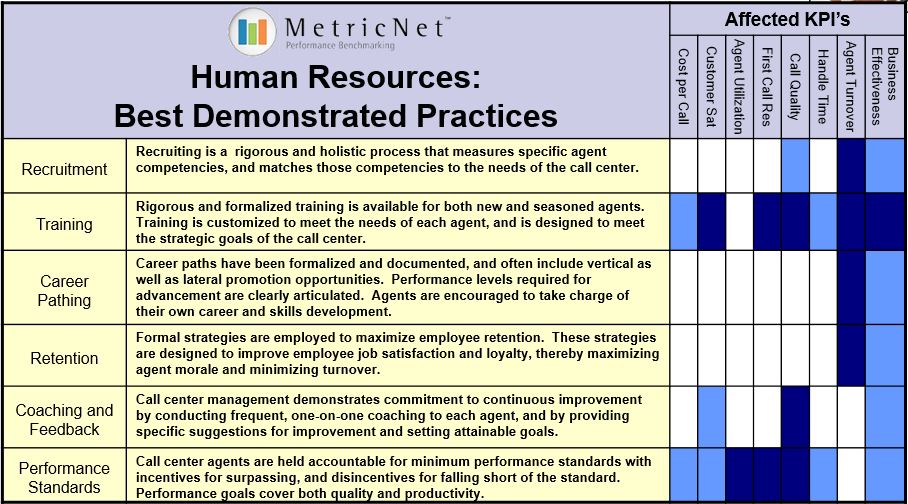 If the cell is dark blue, it means that there is a strong cause and effect relationship between the KPI and the best practice. White cells indicate little to no cause-and-effect relationship and light blue indicates a minor influence.