Why it’s Important
Many service level agreements include an abandonment rate target. Although a low abandonment rate is a worthy objective, many service desks go too far in trying to reduce abandoned calls. Those who pursue this strategy typically believe that a low abandonment rate is a prerequisite for achieving high customer satisfaction levels. The truth, however, is that a low abandonment rate will not necessarily lead to higher levels of customer satisfaction. As discussed in a prior
Metric of the Month, the real driver of customer satisfaction is first contact resolution rate. So while customers may be willing to forgive an occasional abandoned call, they are far less forgiving of calls that are not resolved on first contact.
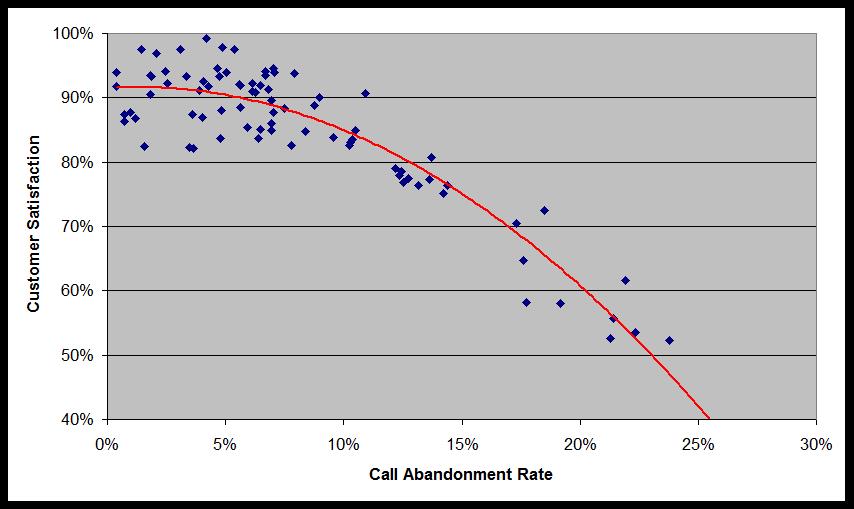
Figure 1 below shows the relationship between abandoned calls and customer satisfaction for a representative cross section of North American service desks. At low abandonment rates the relationship between customer satisfaction and abandonment rate is almost flat, meaning that abandonment rate has very little impact on customer satisfaction levels. It is only when the abandonment rate increases above seven or eight percent that customer satisfaction begins to drop off significantly.
Figure 1: Call Abandonment Rate vs. Customer Satisfaction
While low abandonment rates have virtually no impact on customer satisfaction, they
do have a direct impact on cost per contact. In fact, the lower the abandonment rate is, the higher the cost per contact will be. Figure 2 below illustrates this phenomenon.
Figure 2: Call Abandonment Rate vs. Cost per Contact
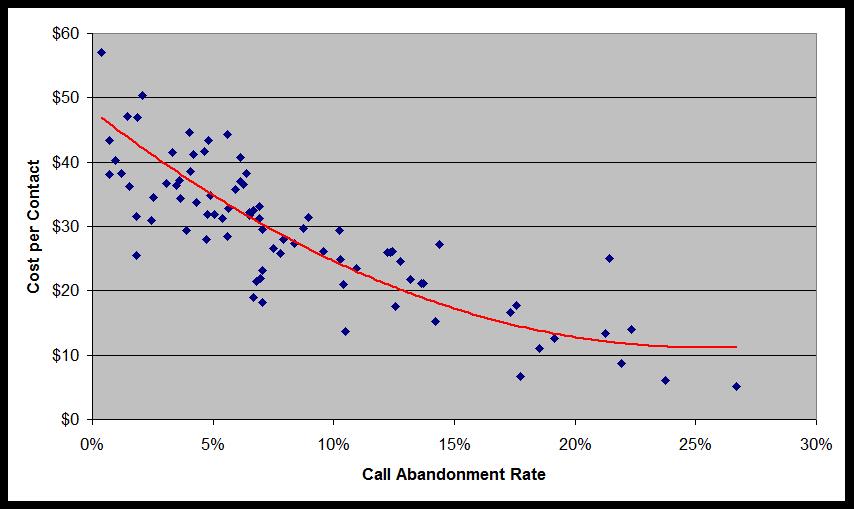
So why do costs go up as the abandonment rate goes down? Because more agent headcount is required to achieve lower abandonment rates, and as headcount increases so too does the cost of support. Let’s say, for example, that a service desk with 10 full time agents has an average abandonment rate of 8%. To reduce the abandonment rate to 4% would require a full time agent headcount of approximately 13. That’s a 30% increase in headcount, for a 4 percentage point decrease in abandonment rate. Is that worth it? Apparently not, because the added headcount increases costs significantly, but produces very little benefit in terms of higher customer satisfaction.
This suggests that there is an optimal range for call abandonment rate. If you go much above this range customer satisfaction will drop off fairly quickly, and if you go much below the range costs will rapidly climb. Benchmarking data shows that the optimal range for abandoned calls is between 4% and 7%. Operating within this range will keep a service desk off the steepest part of the cost curve at low abandonment rates, and also prevent a dramatic drop off in customer satisfaction at higher abandonment rates.
Benchmark Data for Call Abandonment Rate
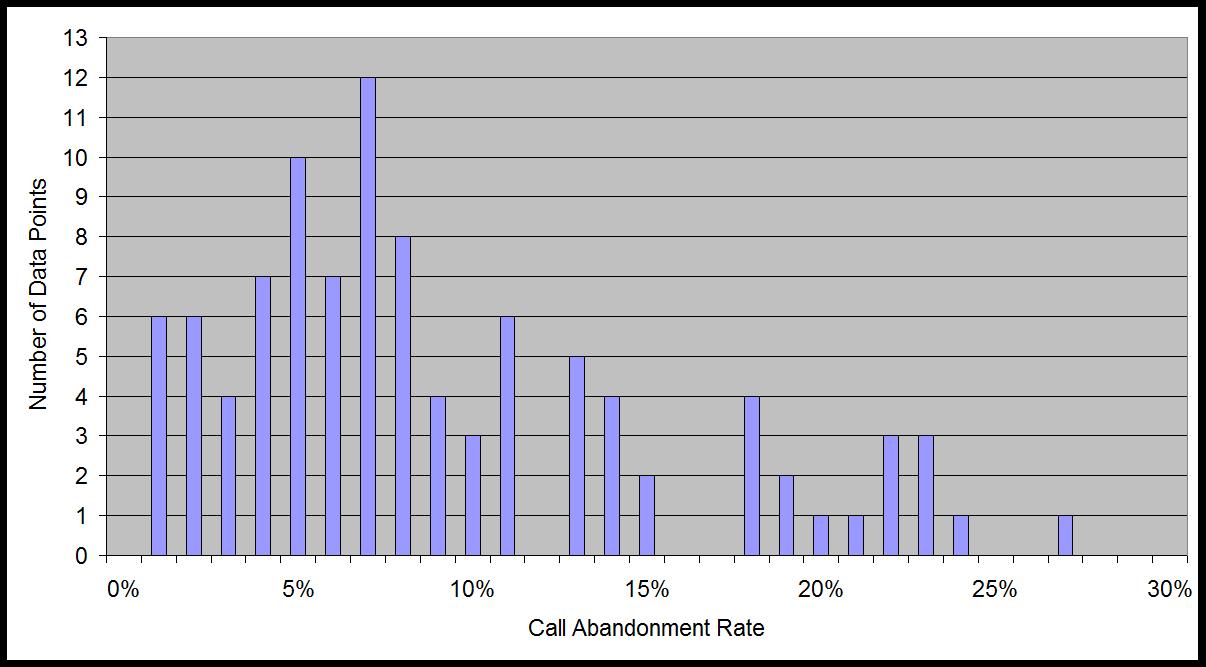
Industry data from MetricNet’s benchmarking database shows that the average call abandonment rate for all service desks is 8.7%, which is slightly above the optimal range. Additionally, the number of service desks operating outside the optimal range is somewhat surprising. This suggests that service desks operating at low call abandonment rates may be unaware of the heavy price they pay for this performance. Conversely, service desks operating at high abandonment rates may be unaware of the adverse impact their abandonment rate has on customer satisfaction.
Figure 3: Industry Benchmarks for Call Abandonment Rate
Please join us for next month’s
Metric of the Month:
Contact Handle Time, a metric that varies widely from one service desk to another, but offers important insights into the overall effectiveness of a support organization.