MetricNet Benchmarking Solution
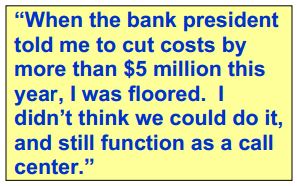
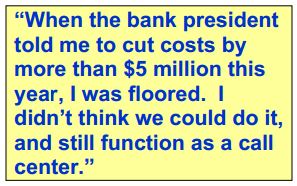
The call center manager at the bank spent some time researching various alternatives for cost cutting, and came to the conclusion that benchmarking would be the quickest, most efficient way to identify the needed cost savings. Additionally, she researched various benchmarking alternatives, and made a decision to participate in MetricNet's
Call Center Benchmark for Banks and Financial Services Companies.
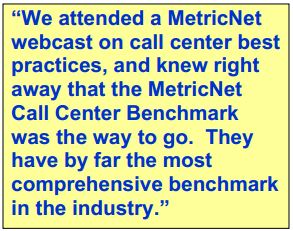 The manager registered for MetricNet’s call center benchmark, and completed the data collection form. MetricNet then reviewed the bank’s call center benchmarking data, and worked with the call center manager to select an appropriate peer group for benchmarking comparison. In all, MetricNet and the client identified 16 call centers that were valid comparison peers for benchmarking. MetricNet then benchmarked the call center versus the peer group and conducted a gap analysis to identify areas for improvement. Once the gap analysis began, a number of obvious cost cutting opportunities came to light.
Benchmarking Diagnosis
The manager registered for MetricNet’s call center benchmark, and completed the data collection form. MetricNet then reviewed the bank’s call center benchmarking data, and worked with the call center manager to select an appropriate peer group for benchmarking comparison. In all, MetricNet and the client identified 16 call centers that were valid comparison peers for benchmarking. MetricNet then benchmarked the call center versus the peer group and conducted a gap analysis to identify areas for improvement. Once the gap analysis began, a number of obvious cost cutting opportunities came to light.
Benchmarking Diagnosis
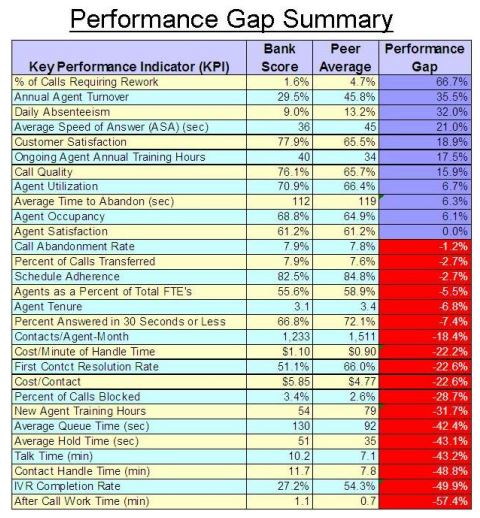
The table below summarizes the benchmarking comparison. As you can see, there were a number of obvious performance gaps vs. the peer group.
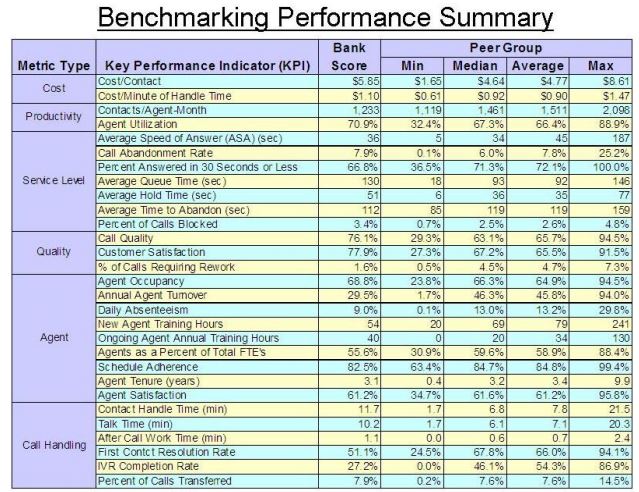
The performance gap on cost per contact ($5.85 for the bank vs. an average of $4.77 for the peer group) does indeed suggest that there may be an opportunity to cut costs. In fact, if the bank was able to reduce its cost per contact to the industry average, a savings of $1.08 per contact, the annual savings would amount to $6.5 million per year (6 million contacts X $1.08 savings per contact = $6.5 million savings per year). This, in turn, would exceed the cost savings goal of $5.4 million established by the bank president!
In order to determine why the cost gap exists, it is helpful to look at the other benchmarking metrics for clues. When interpreted holistically, in their entirety, the benchmarking comparisons generally tell a complete and comprehensive story of a call center’s performance. In other words, they tell the whole story – warts and all! The table below shows a rank ordering of the bank’s performance gaps vs. the peer group average.
Results of the Call Center Benchmark
The table below summarizes the benchmarking performance gaps in rank order. The bank’s high cost per call is clearly a function of the longer handle times at the bank (11.7 minutes for the bank vs. 7.8 minutes for the peer group), and their lower IVR rates (27.2% for the bank, vs. 54.3% for the peer group).
Since IVR calls are far less costly than agent-assisted calls, the bank needs to focus on improving its IVR completion rate. Likewise, reducing the call handle time will reduce labor costs, and hence cost per call. Given the gap in new agent training hours, the bank concluded that a more intensive, focused training program for new agents would help to reduce the call handle times. In combination, a higher IVR completion rate and a lower handle time had the potential to secure the $5.4 million cost reduction the bank president was seeking.
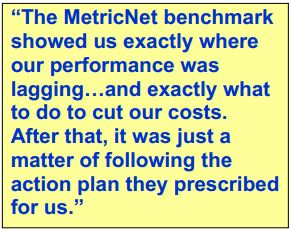
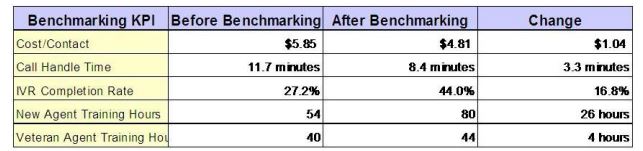
In the six months following the benchmark, the bank rewrote its IVR menus and options in an effort to encourage greater IVR usage by its customers. The result was an increase in IVR completed calls from 27.2% to 44.0% of all calls.
Additionally, the bank implemented a more extensive training program for new agents, and added specific training modules for both new and veteran agents that were focused on handle time reduction. Within eight months following the completion of the benchmark, the call center was able to reduce the average handle time from 11.7 minutes to 8.4 minutes.
The call center met its cost reduction goal, and then some! The increased IVR rate, and reduced call handle time yielded an annual, ongoing savings of $6.1 million! The results of these changes are summarized below.
Benchmarking Results
As always, please feel free to contact
MetricNet if you have any questions or comments about our benchmarking case studies.
Stay tuned for next month’s Case Study: Improving Customer Satisfaction in the Call Center.