- IT Support Can Have a Positive ROI
- Perception Matters as Much as Performance
- Your Success as CIO Depends Upon IT Support
Let’s examine the evidence behind each of these claims.
IT Support Can Have a Positive ROI
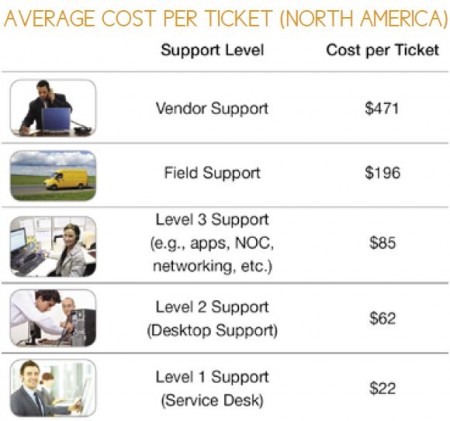
IT support has the potential to deliver positive ROI in at least two ways. The first source of value derives from the ability of support to minimize total cost of ownership (TCO). Last year the average cost per ticket was $22 for the service desk, $62 for desktop support, and $85 for level 3 IT support as shown in Figure 1 below. The well-known industry expression “Get it done at Level 1” is not just a pithy catchphrase…it can literally save your organization millions of dollars a year!
Recent benchmarks show that 21% of all tickets resolved by desktop support could have, and should have been resolved by the level 1 service desk. These escalation errors represent defects in the support process, and result in increased support costs that often go unnoticed because they are rarely tracked. By investing in tools, training, and technology that drive higher resolution rates at level 1, you have the potential to significantly reduce the TCO for IT support.
Figure 1: Cost per Ticket – North American Averages
The second source of value creation and ROI is the result of returning productive hours to the workforce. The majority of today’s workforce is comprised of knowledge workers, all of whom rely upon one or more computing devices to do their jobs. When these devices break down or do not function properly, employee productivity suffers. By preventing these incidents from occurring, and by quickly resolving issues when they do occur, a support organization can return productive hours to the workforce.
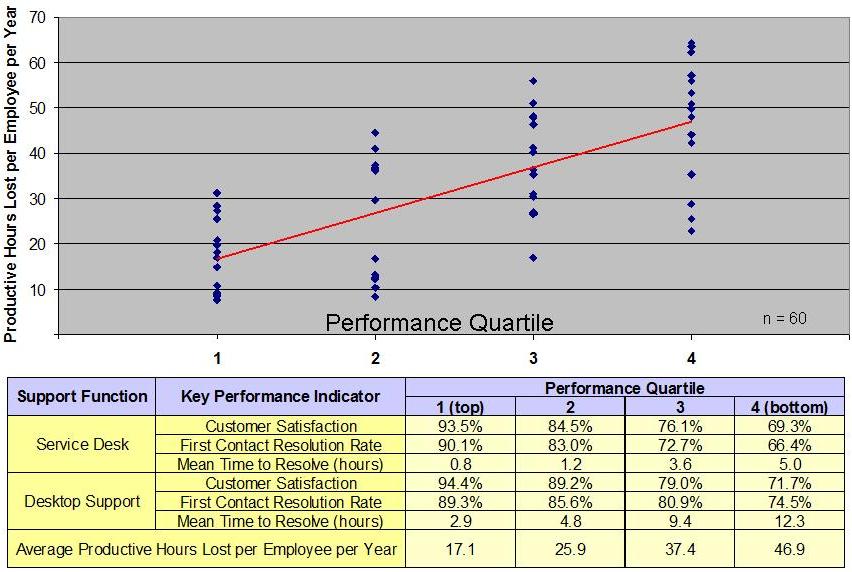
A study conducted by MetricNet and summarized in Figure 2 below concluded that knowledge workers lose an average of 33 hours of productive time per year due to various IT outages, breakdowns, and hardware and software failures. For support groups performing in the top quartile, the lost productivity per worker is just 17 hours per year; about half the industry average. By contrast, employees who receive support from bottom quartile support groups lose an average of 47 productive hours per year.
The difference between the top and bottom quartile performers is a staggering 30 hours per employee per year! Put another way, support organizations in the top quartile are able to return nearly four extra days of productivity annually for every knowledge worker in the enterprise. When multiplied by thousands or even tens of thousands of employees in a company, the productivity gains and ROI delivered by a top performing support group can be enormous!
Figure 2: Economic Benefits of Enhanced User Productivity
Perception Matters as Much as Performance
The old adage that perception is reality is particularly true when it comes to IT support. Top performing support organizations have learned that being good…just isn’t good enough! You also have to remind and demonstrate to your stakeholders on a daily basis just how good you really are. This is the art of image management in IT support.
Most support organizations are not very good at publicizing and promoting their services. And they are even less adept at promoting and managing a positive image. Yet image management is a crucial skill to master for any organization that wants to enjoy full and fair recognition for their efforts. Moreover, it does not require a significant investment of time or money to realize the benefits of effective image management. Simple, proven techniques such as offering downloadable service brochures, session log-on messages, user lunch-and-learn’s, quarterly newsletters, training sessions, and online FAQ’s are among the more common but effective practices employed by leading support organizations to manage, promote, and enhance their images.
The bottom line is that industry leading support groups communicate with their stakeholders at every opportunity, to create awareness and maximize the perception of value. They manage their images as aggressively as they manage their day-to-day performance. The result is that they enjoy significantly higher levels of customer satisfaction than their counterparts who neglect this important discipline.
Your Success as CIO Depends Upon IT Support
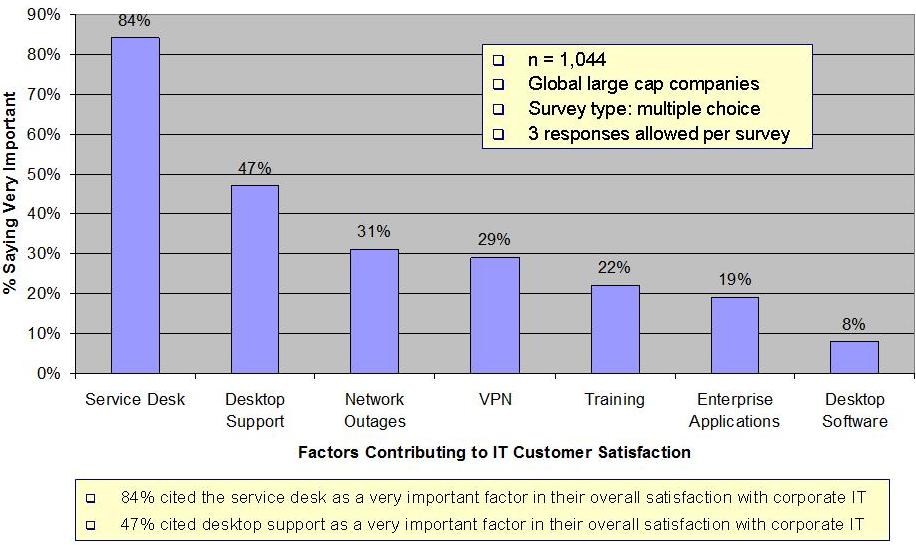
The vast majority of IT customer satisfaction is a direct result of user interactions with support, as illustrated in Figure 3 below. This makes sense, as most end-users are exposed to IT primarily through the service desk and/or desktop support. Please note that Figure 3 refers to customer satisfaction with
all of IT, not just with IT support. The implication is that support represents a highly leveraged opportunity to shape user opinions about IT overall, and high levels of customer satisfaction for support translate into high levels of customer satisfaction for
all of IT.
Figure 3: Impact of Support on IT Customer Satisfaction
As a CIO, you cannot afford to ignore the outsized influence of support on IT customer satisfaction. When customers are happy with IT support, they are happy with all of IT. And when they are happy with all of IT, that reflects well on you, the CIO. The credibility and goodwill bestowed upon you by highly satisfied customers represents a form of capital that empowers you to achieve your goals. Everything from headcount and budget requests, to capital improvements and project approval, are much easier to justify in an environment of highly satisfied customers. For many CIO’s, this direct linkage between IT support and your personal performance is an opportunity just waiting to be exploited.
The CIO Career Success Action Plan
Support is the gateway to IT for the vast majority of your customers. Use this opportunity wisely, for not only can support generate a positive ROI for your enterprise, but your reputation as a CIO depends upon how well you manage this customer interface. I’d like to challenge you to make the most of this opportunity by doing the following:
- Read the monthly performance reports produced by IT support
- Spend an hour each month meeting personally with your support team
- Establish performance goals for support based upon industry benchmarks
- Define and track an ROI metric for IT support
- Develop and implement a promotional plan for IT support
My hope is that this article is a call to action, and prompts the necessary investments, not just in monetary resources, but also in the time and attention that you devote to support. I believe you will discover that the benefits of doing so – for the enterprise, for IT support, and for you personally – far outweigh the costs.
