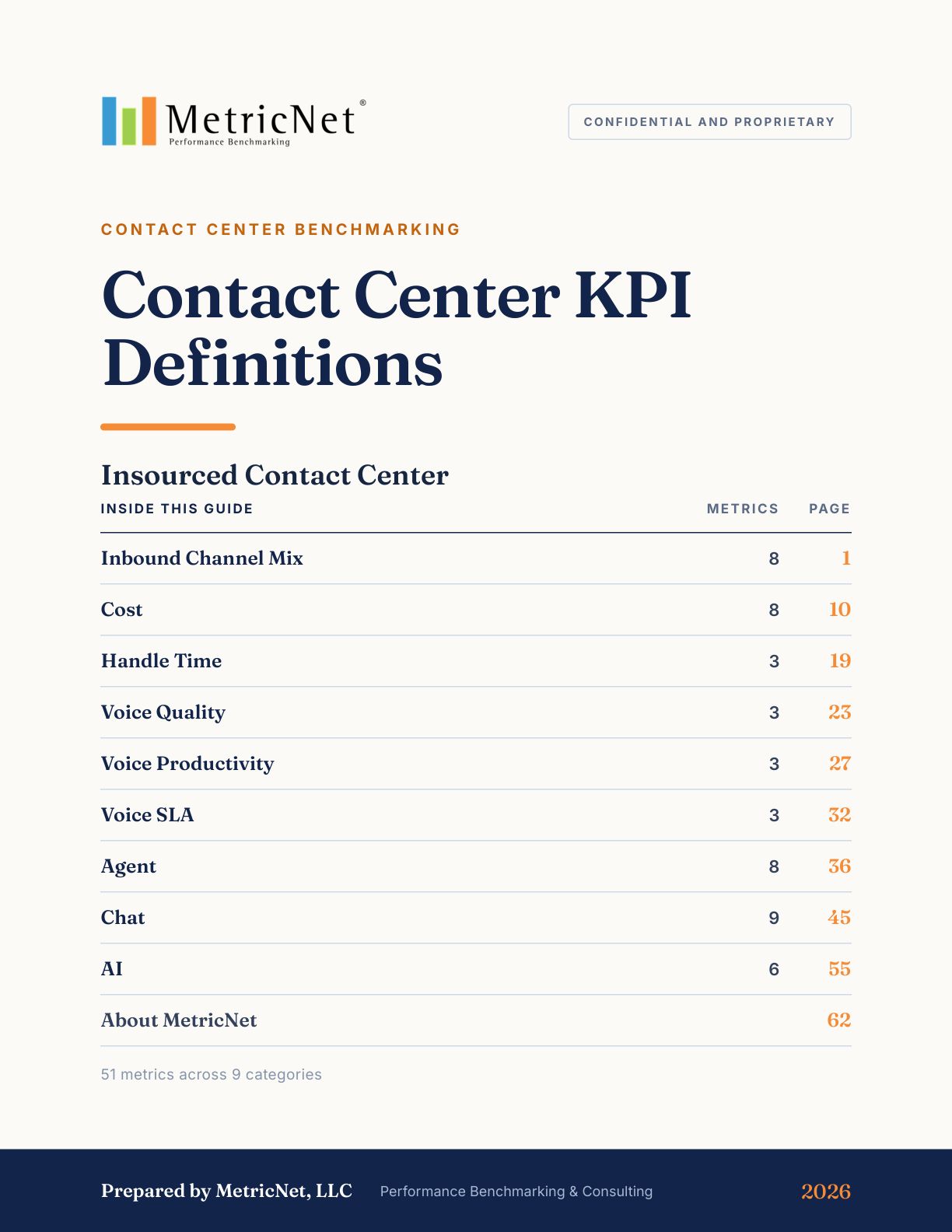

This free 63-page eBook is an introduction to Insourced Contact Center KPIs including definitions, formulas, information on the importance of each metric & key correlations for 51 Insourced Contact Center metrics. A brief overview of each metric is listed below.
Inbound Channel Mix Metrics
Voice % of Total is the percentage of total contacts (including IVR-contained contacts) that originate in the voice channel.
Voice Bot % of Total is the percentage of total contacts (including IVR-contained contacts) that are contained in the voice bot channel. A voice bot is an automated, conversational voice channel that resolves customer contacts without a live agent. A customer who opts out of the voice bot to connect with a live agent does not count toward the Voice Bot % of Total, because the customer did not resolve the issue before contacting a live agent.
Chat % of Total is the percentage of total contacts (including IVR-contained contacts) that originate in the chat channel.
Chat Bot % of Total is the percentage of total contacts (including IVR-contained contacts) that are contained in the chat bot channel. A chat bot is an automated, conversational text channel that resolves customer contacts without a live agent. A customer who opts out of the chat bot to connect with a live agent does not count toward the Chat Bot % of Total, because the customer did not resolve the issue before contacting a live agent.
IVR % of Total is the percentage of contacts that are contained within the IVR, and resolved without the assistance of a live agent. A user who opts out of the IVR to connect with a live agent does not count as part of the IVR % of Total because the user did not resolve the issue before contacting a live agent.
Web Ticket/Email % of Total is the percentage of total contacts (including IVR-contained contacts) that originate in the web ticket/email channel.
AI Self-Help is the percentage of total contacts (including IVR-contained contacts) that are handled through AI self-help. AI self-help is self-service that is assisted by a customer copilot, an AI capability that interprets the customer's request, guides the customer through the steps, and can complete actions on the customer's behalf, all without a live agent.
Other % of Total is the percentage of total contacts (including IVR-contained contacts) that originate in other channels, outside of voice, chat, IVR, and web/email. These other channels may include walk-in and social support.
Cost Metrics
Average Cost per Voice Contact is the total annual operating expense of the voice channel divided by the annual contact volume of the Contact Center originating in the voice channel. Operating expense includes all voice-related employee salaries, overtime pay, benefits, and incentive compensation, plus all contractor, facilities, telecom, desktop computing, software, training, travel, office supplies, and miscellaneous expenses.
Average Cost per Chat Session is the total annual operating expense of the chat channel divided by the annual number of chats handled. Operating expense includes all chat-related employee salaries, overtime pay, benefits, and incentive compensation, plus all contractor, facilities, telecom, desktop computing, software, training, travel, office supplies, and miscellaneous expenses.
Average Cost per Web Ticket/Email Contact is the total annual operating expense of the web-ticket/email channel divided by the annual number of web tickets/email contacts handled. Operating expense includes all web-ticket/email-related employee salaries, overtime pay, benefits, and incentive compensation, plus all contractor, facilities, telecom, desktop computing, software, training, travel, office supplies, and miscellaneous expenses.
Average Cost per Agent-Assisted Contact is the total annual operating expense of all agent-assisted contact channels, including voice, chat, and web ticket/email, divided by the annual inbound agent-assisted contact volume of the Contact Center. Operating expense includes all employee salaries, overtime pay, benefits, and incentive compensation, plus all contractor, facilities, telecom, desktop computing, software, training, travel, office supplies, and miscellaneous expenses.
Average Cost per Contact (including IVR) is the total annual operating expense of the Contact Center, divided by the annual inbound contact volume of the Contact Center, including IVR-contained contacts. Operating expense includes all employee salaries, overtime pay, benefits, and incentive compensation, plus all contractor, facilities, telecom, desktop computing, software, training, travel, office supplies, and miscellaneous expenses. Annual inbound contact volume includes contacts from all sources: live voice, voicemail, email, web portal, chat, walk-in, IVR, etc.
Average Cost per Voice Minute is simply the Average Cost per Voice Contact divided by the average Voice Handle Time.
Average Cost per Chat Minute is simply the Average Cost per Chat Session divided by the average Chat Handle Time.
Average Cost per Web Ticket/Email Minute is simply the Average Cost per Web Ticket/Email Contact divided by the average Web/Email Handle Time.
Handle Time Metrics
Voice Handle Time is the average time (in minutes) that an agent spends on each call, including talk time, hold time, and after-call work time.
Chat Handle Time is the average time (in minutes) that an agent spends on each chat, including chat time and after-chat work time.
Web/Email Handle Time is the average time that an agent spends handling each web ticket or email contact.
Voice Quality Metrics
Voice Customer Satisfaction is the percentage of customers who are either satisfied or very satisfied with their Contact Center experience in the voice channel. This metric can be captured in a number of ways, including automatic after-call IVR surveys, follow-up outbound (live-agent) calls, email surveys, postal surveys, etc.
Net First Contact Resolution Rate applies only to live voice contacts. It is a percentage, equal to the number of inbound calls that are resolved on the first interaction with the customer, divided by all calls that are potentially resolvable on first contact. Calls that involve a customer callback, or are otherwise unresolved on the first contact for any reason, do not qualify for Net First Contact Resolution. Calls that cannot be resolved on first contact, such as a product break/fix, are not included in the denominator of Net First Contact Resolution Rate. (Some Contact Centers also measure FCR for email by considering an email resolved on first contact if the customer receives a resolution within one hour of submitting the email.)
Call Quality is no consistent methodology for measuring Call Quality in the Contact Center industry, most Contact Centers have developed their own scoring system for grading the quality of a call. Most will measure call quality on a scale of zero to 100%, and evaluate such things as agent courtesy, professionalism, empathy, timeliness of resolution, quality of resolution, adherence to the script, etc.
Voice Productivity Metrics
Voice Agent Utilization is the average time that a voice agent spends handling both inbound and outbound calls per month, divided by the number of work hours in a given month. (See the more thorough definition on the following page.)
Inbound Voice Contacts per Agent per Month is the average monthly inbound call volume divided by the average full-time equivalent (FTE) voice-agent headcount. Voice-agent headcount is the average FTE number of employees and contractors handling voice contacts.
Voice, Chat, and Email Agents as a % of Total Contact Center Headcount is the average Full Time Equivalent (FTE) agent headcount divided by the average total Contact Center headcount. It is expressed as a percentage, and represents the percentage of total Contact Center personnel who are engaged in direct customer-service activities. Headcount includes both employees and contractors.
Voice SLA Metrics
Average Speed of Answer (ASA) is the total wait time that callers are in queue, divided by the number of calls handled. This includes calls handled by an Interactive Voice Response (IVR) system, as well as calls handled by live agents. Most Automatic Call Distributor (ACD) systems measure this number.
Call Abandonment Rate is the percentage of calls that were connected to the ACD, but were disconnected by the caller before reaching an agent or before completing a process within the IVR.
% Answered in 30 Seconds is fairly self-explanatory. It is the percentage of all inbound calls that are answered by a live agent within 30 seconds. For those who don't track this exact metric, but track a similar metric such as % Answered in 60 Seconds, MetricNet uses a conversion formula to calculate the equivalent percentage of calls answered within 30 seconds.
Agent Metrics
Annual Agent Turnover is the average percentage of agents that leave the agent role in the Contact Center, for any reason (voluntarily or involuntarily), in a year. New agents who leave during their initial training period should not be included in the numerator when calculating turnover.
Daily Agent Absenteeism is the average percentage of agents with an unplanned absence on any given day. It is calculated by dividing the number of unplanned absences in a given period of time by the total number of scheduled agent-workdays during the same period.
Agent Schedule Adherence measures whether agents are in their seats ready to accept calls as scheduled. That is, it measures how well a Contact Center's agents are "adhering" to the schedule. Agent Schedule Adherence is equal to the actual time that an agent is logged in to the system ready to accept calls as scheduled, divided by the total time the agent is scheduled to be available to accept calls.
Agent Occupancy is a percentage, equal to the amount of time that a voice-support agent is in his or her seat and connected to the ACD and either engaged in a call or ready to answer a call, divided by the agent's total number of hours at work (excluding break time and lunch time).
New Agent Training Hours is somewhat self-explanatory. New Agent Training Hours is the number of training hours (including classroom, computer-based training, self-study, shadowing, being coached, and on-the-job training) that a new agent receives before he or she is allowed to handle customer contacts independently.
Annual Agent Training Hours is the average number of training hours (including classroom, computer-based training, self-study, shadowing, etc.) that an agent receives on an annual basis. This number includes any training hours that an agent receives that are not part of the agent's initial (new-agent) training. But it does not include routine team meetings, shift handoffs, or other activities that do not involve formal training.
Agent Tenure is the average number of months that each agent has worked in your Contact Center.
Agent Job Satisfaction is the percentage of agents in a Contact Center who are either satisfied or very satisfied with their jobs.
Chat Metrics
% of Contacts Originating in Chat is the percentage of all contacts coming into the Contact Center that originate in the chat channel. As a chat channel matures, this metric normally increases.
% of Contacts Resolved in Chat is the percentage of all contacts coming into the Contact Center that originate and are resolved in the chat channel. This number will be less than or equal to the % of Contacts Originating in Chat. Once again, as the chat channel matures, this metric normally increases.
Chat First Contact Resolution Rate applies only to live chat contacts. It is the percentage of chat sessions that are resolved on the first interaction with the customer, divided by all chat sessions that are potentially resolvable on first contact. Chat sessions that cannot be resolved on first contact, such as a product break/fix, are not included in the denominator of Chat First Contact Resolution Rate. Chat sessions unresolved in the first chat session for any reason do not qualify for Chat FCR.
Chat Abandonment Rate is the percentage of chats that were connected, but were disconnected by the customer before reaching an agent or before completing a process within the chatbot.
% Failover Rate from Chat to Voice measures the percentage of chats that "failover" to a live-agent voice contact. This happens when the agent or the caller feels that voice communication is needed, and they revert from the chat channel to the voice channel to complete a transaction.
Customer Satisfaction in the Chat Channel is the percentage of customers who are either satisfied or very satisfied with their Contact Center experience in the chat channel. This metric can be captured in a number of ways, including automatic after-chat pop-up surveys, follow-up outbound (live-agent) calls, email surveys, postal surveys, etc.
Average Concurrent Chat Sessions is the average number of chat sessions that a chat agent has open at any given time.
Max Concurrent Chat Sessions Most organizations will limit the number of concurrent sessions an agent is allowed to handle. Newer agents might be limited to a single chat session at a time, while more experienced agents might be allowed to handle as many as four concurrent chat sessions.
Number of Chat Sessions per Chat Agent per Month is the average monthly chat volume divided by the average full-time equivalent (FTE) chat-agent headcount. Chat-agent headcount is the average FTE number of employees and contractors handling chats.
AI Metrics
AI Deflection Rate is the percentage of inbound contacts that originate in an AI channel rather than being routed directly to a live agent. AI channels include voice bots, chat bots, and AI self-help (self-service that is assisted by a customer copilot).
AI Resolution Rate is the percentage of inbound contacts that are resolved in an AI channel without any live agent assistance. A contact counts toward the AI Resolution Rate only when the customer's need is fully resolved within the AI channel. A contact that is deflected into an AI channel but later handed off to a live agent does not qualify.
AI First Contact Resolution (AI FCR) is the percentage of inbound contacts that are resolved on the first interaction within an AI channel, without a follow-up contact and without escalation to a live agent. As with Net First Contact Resolution, contacts that cannot be resolved on first contact for reasons outside the Contact Center's control are excluded from the denominator.
AI Customer Satisfaction is the percentage of customers who are either satisfied or very satisfied with their AI channel experience. It is captured the same way as Voice Customer Satisfaction and Customer Satisfaction in the Chat Channel, but is measured specifically for contacts handled in a voice bot, chat bot, or AI self-help channel.
% Agent Copilot Assisted Resolution is the percentage of contacts resolved by a live agent that are assisted by an agent copilot. An agent copilot is an AI capability that supports the live agent during the contact, for example by surfacing knowledge, suggesting responses, or automating after-contact work.
% Customer Copilot Assisted Resolution is the percentage of customers who receive copilot assistance in the self-help channel. A customer copilot is an AI capability that guides the customer through self-service, for example by interpreting the request, walking the customer through the steps, or completing actions on the customer's behalf.