The Origins of Benchmarking
In 1989 Xerox Corporation won the Malcolm Baldrige National Quality Award. The Baldrige Award is the most prestigious recognition of quality bestowed upon an American company, and for Xerox it represented the culmination of a long struggle back to preeminence in the worldwide copier business.
Although Xerox dominated the copier market until the mid-1970’s, by 1980 the company had been so devastated by foreign competition that its very survival was threatened. Xerox’s fall was so quick, and so decisive, that most believed the company would not survive the 1980’s. The company did survive, of course, but few people are aware of the crucial role that benchmarking played in Xerox’s return to preeminence.
In fact, benchmarking was the linchpin of Xerox’s success in the 1980’s and beyond. During a decade when most American companies were under attack for the poor quality of their goods and services and when most companies lost market share to their foreign rivals, Xerox actually tripled its market share, improved the quality of its products as much as a hundredfold, and reduced its production costs by more than fifty percent.
Nothing so starkly illustrates the power of benchmarking as the renewal of Xerox Corporation. Although few companies today are as bad off as Xerox was in 1979, and few markets are as competitive as the copier business was in the 1970’s, benchmarking is not just a tool for the “down-and-out.” It has been applied with equal effectiveness in successful companies, and in companies that are struggling. It has helped companies realize dramatic gains in industries as disparate as chemicals and banking, and in functions as far reaching as R&D and customer service. The complete story of Xerox’s rebirth through benchmarking is chronicled by Robert Camp in his book, Benchmarking: The Search for Industry Best Practices That Lead to Superior Performance.
Since Xerox pioneered the formal methodology of benchmarking in the 1980’s, the concept has been adopted by corporations worldwide. And with good reason: applied properly, benchmarking has the potential to complete transform an organization, and accelerate the path to world-class performance.
Benchmarking Defined
Benchmarking is the art of improving your performance by observing, studying, and internalizing the practices of your strongest competitors. The concept is not new. It has been around since the time Neanderthals tried to emulate the more successful CroMagnon by fabricating hunting tools from stone. But the rigorous discipline of benchmarking is new. Since the early 1980’s, the practice of benchmarking has grown explosively, fueled by high-visibility success stories like the Xerox turnaround, and the meteoric rise of General Electric whose market value increased by more than $400 billion under the stewardship of Jack Welch, and with the aid of benchmarking.
Benchmarking is a common sense process that most people engage in every day without realizing it. At work we monitor the performance of our peers, compare our own career progress, and modify our behavior based upon what’s working for those around us. Likewise on the golf course, we study the grip, swing, and stance of the best player on the course for clues on how to improve our own game. In fact, any time we observe and learn from someone who is more accomplished than ourselves, we perform a rudimentary form of benchmarking.
Any function within a company can benefit from benchmarking. It is not unique to manufacturing, R&D, sales, or any other activity. In fact, some of the greatest benchmarking success stories come from the ranks of the Service Desk industry, where many companies have built a formidable service-based competitive advantage through the continuous practice of benchmarking.
What Cost? What Benefit?
As in any business undertaking, it is important to ask what benefit one might expect to gain from benchmarking the Service Desk, and what the costs of benchmarking will be. Historically, due to a relative dearth of benchmarking data, the cost of performing a Service Desk benchmark was quite high. It was not uncommon for a company to pay $100,000 or more for a comprehensive Service Desk benchmark. Fortunately, through the creation of large-scale benchmarking databases, companies such as MetricNet have reduced this cost by an order of magnitude, and a high quality Service Desk benchmark can now be had for around $15,000. The removal of this financial constraint puts benchmarking within the reach of virtually any Service Desk. Now, the biggest cost in benchmarking is no longer the price paid to an outside benchmarking firm, but rather the cost of the internal resources required to conduct the benchmark. The time an effort required for successful benchmarking is not insignificant, and can run into the hundreds of hours if not properly managed. As will be discussed in more detail below, the most resource intensive step in the process is data collection. It is critical to factor this “cost” into any benchmarking effort, as failure to do so will almost certainly doom any benchmarking project from the outset.
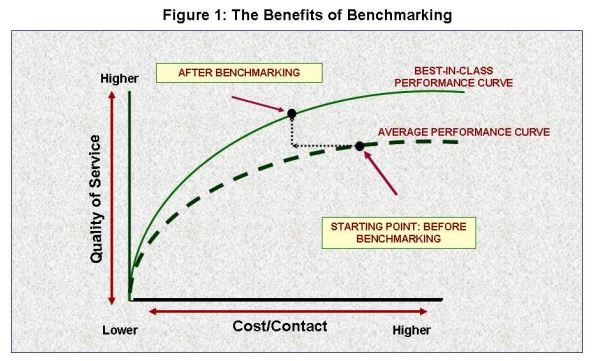
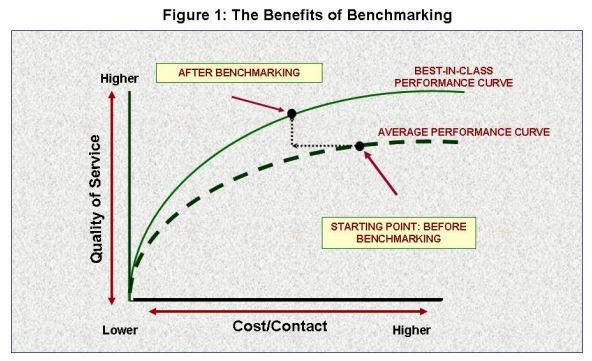
The question of benefits is a more difficult one to answer since the payoff from benchmarking won’t be known until the benchmark has been completed. However, what we can say is that the benefits of Service Desk benchmarking come in two forms: lower costs, and higher quality levels. In one recent Service Desk benchmark completed by MetricNet, an energy utility learned how to reduce their call handle time by 25 seconds, increase the number of agent-less calls by 8 percent through greater usage of their Automated Password Reset tool, and improved their agent utilization by 4% through improved workforce scheduling. In combination, these findings reduced the cost per call from $22.44 to $17.11. At 120,000 contacts per year, these relatively easy-to-implement actions saved the company $636,000 annually. All for an investment of less than $15,000!
In addition to cost savings, many Service Desks that perform benchmarking are also looking for ways to improve their quality of service. This can be measured in numerous ways, including improved service levels, quicker handle times, and improved resolution rates. But the ultimate judge of quality is the customer, and any improvement in service levels must result in higher levels of customer satisfaction to be of any value.
Figure 1 below illustrates the two benefits of benchmarking. Performed correctly, benchmarking can simultaneously reduce costs while improving the overall quality of customer service.
The Benchmarking Approach
Although benchmarking is a rigorous, analytical process, it is relatively straightforward. The basic approach is illustrated in Figure 2 below.
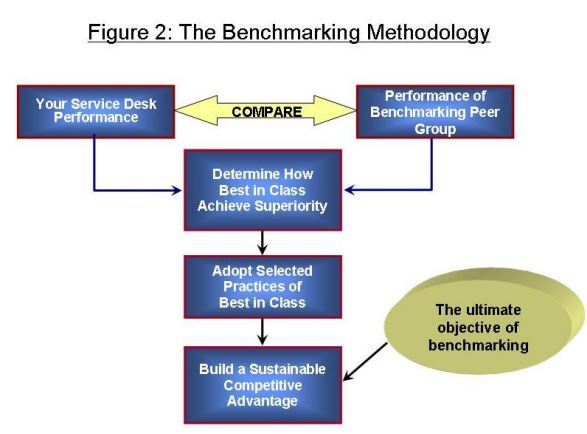
More specifically, there are seven steps in the benchmarking process, including:
1. Select the area to be benchmarked. Since we are talking about benchmarking the Service Desk, this step is a foregone conclusion.
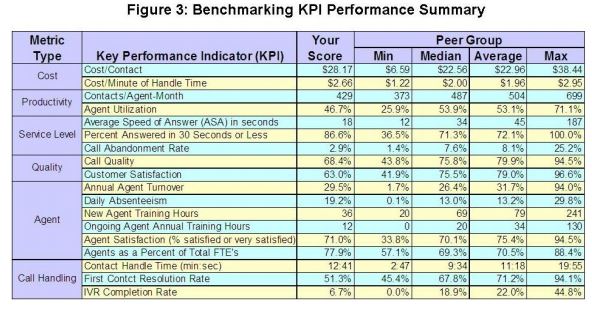
2. Identify key performance metrics to benchmark and compare. The metrics for Service Desk benchmarking fall into six categories: cost metrics, which include Cost per Contact; productivity metrics, which include Agent Utilization; service level metrics, which include Average Speed of Answer; quality metrics, which include Customer Satisfaction; call handling metrics which include Average Handle Time; and agent metrics, which include Agent Satisfaction. Although not a comprehensive listing, these are some of the key metrics that should be
included in any Service Desk benchmark.
3. Select the benchmarking peer group. This is critical for ensuring a fair, apples-to-apples comparison of data. Typically, but not always, the
benchmarking peer group will be composed of other companies in your industry. In the case of the Service Desk, a lot can be learned by benchmarking companies from outside your immediate industry, so it is not uncommon to see multiple industries represented in a Service Desk benchmark.
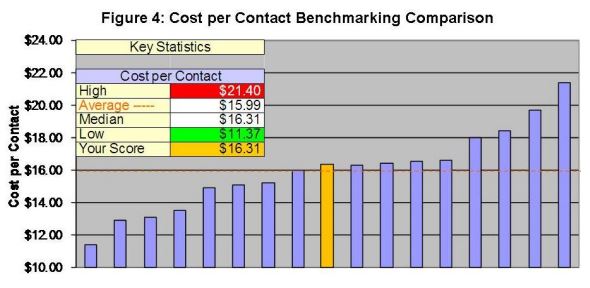
4. and 5. Collect the peer group data, and collect your own Service Desk data. Thorough and accurate data collection is the cornerstone of successful benchmarking. This is also the most time consuming step in benchmarking. It is therefore critical to rigorously define each metric, and ensure that all Service Desks in the benchmark interpret the data collection questionnaire in the same way. As Illustrated in Figures 3 and 4 below, this step gets to the heart of benchmarking, and enables you to identify the performance gaps in your own Service Desk.
6. Develop Strategies for Improved Performance. Without an action plan to improve performance, benchmarking is a pointless exercise. Ironically, this is one of the simplest steps in the benchmarking process, but it adds the most value.
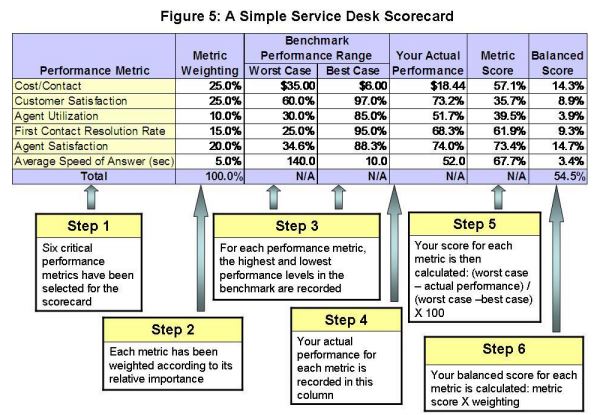
7. Implement and Monitor Results. Once the strategies for improved performance have been identified, you are in a position to implement your action plan. Additionally, as illustrated in Figure 5 below, the results of your benchmark can be imported into a simple scorecard that allows you to track and trend your performance over time. This is where the payoff comes, so don’t shortchange this step!
Key Success Factors for Effective Benchmarking
Over the past eighteen years, the principals of MetricNet have conducted several thousand benchmarks, including hundreds in the Service Desk industry. During this time, we have learned a number of important lessons that might be helpful for any Service Desk wishing to improve its performance through benchmarking. These include:
- The widespread practice of benchmarking. As a proven management tool, benchmarking is now employed by most corporations worldwide. However, the practice of benchmarking is not nearly as widespread among Service Desks. Perhaps this is because many companies view the Service Desk as a “support function”, where no competitive advantage can be gained. Or perhaps it is because many Service Desks today are so busy focusing on fighting fires and mere survival, that they have no time to position themselves for world-class leadership tomorrow. The reality, however, is that many companies have built a sustainable competitive advantage in their Service Desks by improving customer loyalty and retention through benchmarking. Tomorrow’s requirements for survival – and leadership – demand benchmarking today!
- Prerequisites for successful benchmarking. A number of factors go into a successful benchmarking project, but the two most important are 1) internal management support, and 2) adequate resources to get the job done. The importance of management support should be self-evident, but too many Service Desks embark upon benchmarking without understanding the level of resources required to get the job done. As previously mentioned, a handful of industry experts offer a quality Service Desk benchmark for under $15,000, but even with outside assistance, you must be prepared to make the time commitment necessary to ensure the success of your benchmark.Service Desk managers often grapple with fear issues when considering benchmarking. Indeed, benchmarking can be confusing, intimidating and stressful if approached incorrectly. Outsourcing or downsizing decisions tied to poor performance, the significant resources required of a benchmarking effort, and the lack of actionable results are major concerns. At the beginning of the benchmarking process, organizations must address such concerns by involving all affected parties, clearly communicating the goals and benefits of benchmarking, setting realistic expectations of the results, and establishing a rigorous approach to managing the benchmarking process.
- Success stories from the industry. Over the years, we have witnessed literally hundreds of benchmarking success stories. These span the gambit, from Service Desks that are already world-class, yet still manage to continuously improve their performance through benchmarking, to global enterprises that have literally redefined their industries by building a service-based competitive advantage in their Service Desk. You too can achieve this level of success by taking the initiative to benchmark your Service Desk!
Conclusion
Benchmarking is a proven, analytical process that has helped literally thousands of Service Desks dramatically improve their performance. The benefits achieved from benchmarking are directly proportional to the time and effort invested in the process. Although it is no panacea, Service Desks that engage in benchmarking on an ongoing basis eventually achieve world-class levels of performance by continuously reducing their costs, while simultaneously improving the quality of services offered to their callers.
It is a given that people, process and technology are in constant flux. Businesses will become increasingly competitive, technology will become more ubiquitous and usable, and the inexorable rise in customer expectations will make
continuous quality improvement a necessity. All of this makes benchmarking an imperative because it marks the path to world-class performance for your Service Desk.
“In a visionary company, [continuous improvement] is an institutionalized habit — a disciplined way of life — ingrained into the fabric of the organization and reinforced by tangible mechanisms that create discontent with the status quo,” stated J. Collins and J. Porras in Built To Last. The world-class Service Desks of tomorrow are the visionaries of today; they stimulate change to constantly deliver value.
That is the essence of benchmarking. It is not just a comparative exercise. Benchmarking involves comparing your performance to others and asking, “How did they achieve a higher level of customer satisfaction? How did they get to a lower cost per call? How did they drive customer loyalty by virtue of the Service Desk portal?” That is what we are after here. Inasmuch as the Service Desk has historically been viewed as a “non-core” activity, the field is wide open for forward thinking Service Desk managers to take the initiative and build a service-based competitive advantage through benchmarking!
Due to space limitations, this article barely begins to scratch the surface on the topic of Service Desk benchmarking. In subsequent articles, MetricNet will continue its series on Successful Benchmarking for the Service Desk, with articles on:
- Service Desk KPI’s: The Five Most Important Performance Indicators for Successful Benchmarking
- Benchmarking Peer Group Selection: How to Ensure a Fair, Apples-to-Apples Comparison in Your Service Desk Benchmark
- The Benchmarking Performance Gap: Diagnosing the Causal Factors Behind Your Service Desk’s Performance Gaps
- The Cost vs. Quality Tradeoff: How Benchmarking Can Help You Achieve the Right Balance Between Cost and Quality in Your Service Desk
- The Benchmarking Payoff: How to Build a Hard-Hitting Action Plan From Your Service Desk Benchmark
Stay tuned for next month’s article!