Why the biggest AI impact on desktop support and field services may not be faster technicians, but fewer tickets reaching them at all.
A MetricNet White Paper by Jeff Rumburg, Co-founder & Managing Partner, MetricNet · 2026
Executive Summary
Most discussions of artificial intelligence in IT service management focus on Level 1: the service desk, virtual agents, chatbots, copilots, knowledge retrieval, and automated fulfillment. That focus is understandable, but it misses one of the most important downstream effects of AI. AI is beginning to reshape desktop support and field services even when those organizations are not the primary owners of the AI technology.
The mechanism is shift left. Issues that historically traveled to a deskside technician, a device-side specialist, or a field technician are increasingly being resolved earlier in the support chain. Service desk analysts can use AI to conduct deeper diagnosis remotely. End users and device owners can consult an LLM before they contact support at all. And when higher-tier technicians do become involved, they can use AI as a troubleshooting copilot to reduce average work time.
MetricNet benchmark data is beginning to reflect the change. For many years, desktop support demand averaged roughly 0.50 tickets per user per month. That figure has moved closer to 0.40 - a 20% decline. The economics make the shift especially important: a fully loaded Level 1 ticket in North America costs about $20, compared with roughly $70 for desktop support and about $200 for field services, where travel and onsite time are part of the cost structure.
The biggest AI impact on desktop support and field services may not be faster technicians. It may be fewer tickets reaching them at all.
Want this measured continuously rather than once a year? Try Artevys
The current AI narrative in IT support is overwhelmingly centered on the service desk. Industry articles describe virtual agents that answer common questions, copilots that assist analysts, automated password and access workflows, AI-generated knowledge, intelligent routing, ticket summarization, and eventually autonomous remediation. These are all important developments, and they are already changing Level 1 support.
Desktop support and field services receive much less attention. That is partly because physical support appears harder to automate. A failed monitor may still need to be replaced. A network device in a branch office may still require hands-on work. A technician may still have to visit a laboratory, data center, retail location, or employee workspace.
But this framing confuses automation with impact. AI does not have to physically replace the technician to reduce desktop and field workload. It only has to prevent some incidents from escalating to that level. That is precisely what is beginning to happen.
The Unexpected Effect: AI Is Accelerating Shift Left
For years, shift left was a widely discussed objective: move resolution to the least expensive competent level of support. In practice, many organizations struggled to make it happen consistently. Level 1 analysts often lacked the diagnostic depth, system context, or confidence to resolve issues that appeared even moderately complex, so tickets were escalated to desktop support or dispatched to field services.
AI changes that equation. A service desk analyst can query an LLM or an enterprise copilot during troubleshooting, compare symptoms to known failure patterns, generate a structured diagnostic sequence, interpret error messages, and identify likely root causes before escalating. The analyst does not suddenly become a field engineer, but the effective troubleshooting depth of Level 1 increases.
At the same time, users are shifting work even farther left. A technically capable employee, application owner, lab user, or device owner can describe a problem to an LLM, follow a guided diagnostic sequence, and resolve the issue without creating a ticket. In MetricNet's earlier white paper, Who Do You Call First?, this was described as invisible AI deflection: support demand disappears before the formal support ecosystem ever sees it.
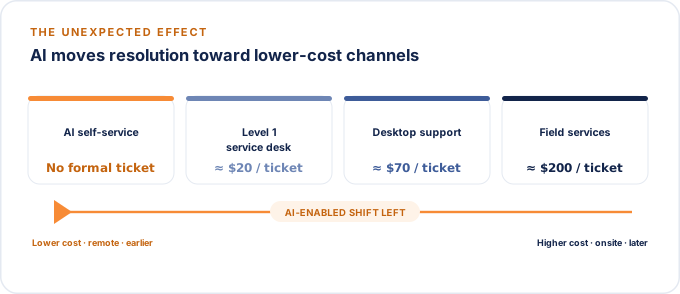
Figure 1. AI-enabled shift left moves resolution toward lower-cost, remote support channels.
Source: MetricNet support cost benchmarks; costs shown are approximate fully loaded North American averages.
The result is a support chain with more resolution occurring to the left and less work reaching the expensive layers on the right. AI therefore affects desktop support and field services indirectly through demand migration, not merely directly through technician productivity.
The Benchmark Signal: Fewer Desktop Tickets per User
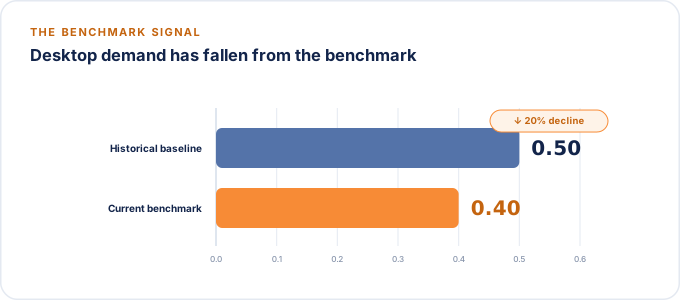
One of the clearest indicators is ticket demand. Historically, desktop support organizations commonly experienced about 0.50 tickets per end user per month. MetricNet benchmark data now shows that figure closer to 0.40. A decline of one-tenth of a ticket per user may sound modest, but across a large enterprise it is substantial.
In a 10,000-user environment, for example, the difference between 0.50 and 0.40 tickets per user per month represents approximately 1,000 fewer desktop support tickets every month, or 12,000 fewer tickets per year. At a fully loaded cost of roughly $70 per desktop ticket, that demand reduction has a significant economic consequence even before considering field-service dispatches that may also be avoided.
Figure 2. Desktop support demand has declined from the historical benchmark.
Not every part of that decline can be attributed to AI. Better endpoint management, more reliable hardware, remote management tools, device standardization, software-as-a-service, and improved knowledge have all contributed. But AI has become a new and increasingly important accelerator because it expands both self-resolution and Level 1 diagnostic capability.
Why the Economics Are So Compelling
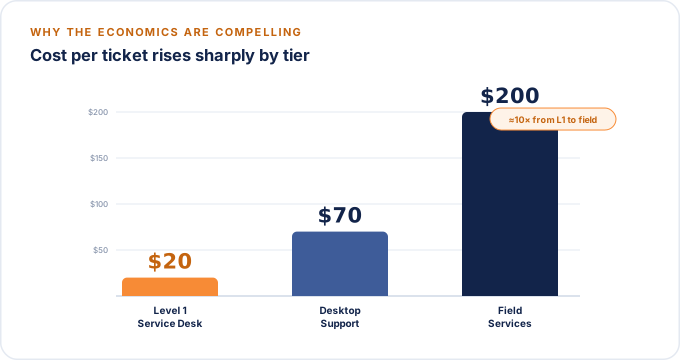
Shift left has always had a favorable cost profile, but AI increases the number of tickets that can realistically be shifted. The cost differential between support levels is large. A typical fully loaded Level 1 ticket in North America costs about $20. Desktop support averages about $70. Field services can approach $200 per ticket because travel time, mileage, dispatch coordination, onsite labor, and lower technician utilization are embedded in the economics.
Figure 3. The cost of support rises sharply as work moves farther to the right.
Source: MetricNet benchmarking data; approximate fully loaded North American averages.
Moving one ticket from field services to Level 1 can therefore reduce the fully loaded cost by roughly $180. Moving a desktop support ticket to Level 1 can save about $50. And when an end user resolves the issue with an LLM before a ticket is opened, the formal support cost may be close to zero. This is why the AI effect on higher tiers can be economically larger than it first appears.
The strategic point is not that every desktop or field ticket can be shifted left. Many cannot. Hardware replacement, cabling, physical installation, damaged devices, secure environments, and complex infrastructure incidents will continue to require hands-on expertise. The opportunity lies in removing the portion of higher-tier demand that never needed to be higher-tier work in the first place.
Three Ways AI Reduces Higher-Tier Work
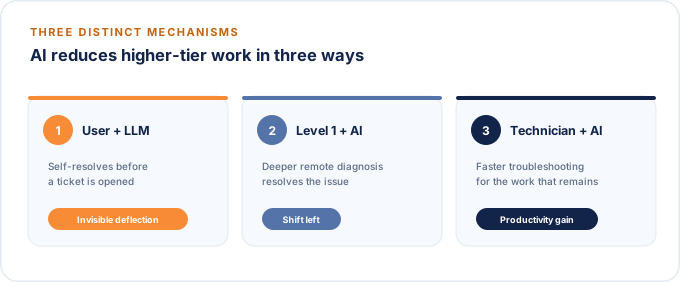
AI is changing desktop support and field services through three distinct mechanisms. Understanding the difference matters because each mechanism should be measured differently.
Figure 4. AI reduces desktop and field workload through deflection, shift left, and technician productivity.
First is user-adopted AI. The employee or device owner turns to an LLM, diagnoses the issue, and never enters the formal support channel. This is the most difficult form of AI impact to measure because there is no ticket to count.
Second is Level 1 AI assistance. The service desk receives the contact, but AI gives the analyst enough diagnostic depth to resolve it remotely. The ticket exists, but the escalation does not. This is classic shift left, newly enabled by AI.
Third is technician AI assistance. A desktop or field technician uses AI during the work itself to search knowledge, interpret logs, compare symptoms, structure tests, or generate likely next steps. This reduces work time per ticket and can improve consistency, but it is only one part of the overall value story. The first two mechanisms reduce the amount of higher-tier work that exists at all.
A Real-World Example: The Support Calls That Never Happened
A recent personal experience illustrates the point. I installed an Eero mesh network in my home and then changed the network name and password. Roughly 50 connected devices - computers, cameras, televisions, smart phones, security components, and other equipment - had to be reconnected or reconfigured. In the past, a project like this could easily have produced multiple support calls and possibly an onsite visit.
Instead, I used an LLM as the troubleshooting interface. It walked me through the network setup, device reconnection, camera resets, and related configuration questions step by step. I did not need to call Eero technical support, Spectrum, or ADT. More important, I did not need a technician dispatched to the house.
That is invisible deflection in practical terms. Several potential Level 1 contacts disappeared, and at least some potential field-service demand disappeared with them. The support organizations involved did not have to deploy the LLM themselves to benefit from the reduction in demand. The user (me!) accessed the AI through a single conversational LLM.
What This Means for Desktop Support and Field Services Leaders
The first implication is workload. As shift left accelerates, desktop support and field services should expect fewer tickets per user, per device, and per supported location. Staffing models that assume historical demand ratios will gradually overstate labor requirements.
The second implication is ticket mix. The incidents that remain will be more physical, more ambiguous, more security-sensitive, or more technically difficult. This means fewer tickets, but does not necessarily mean easier work. Higher-tier technicians will increasingly concentrate on the exceptions that could not be resolved by users, Level 1, automation, or remote tooling.
The third implication is skill. Desktop and field technicians should be trained to use enterprise-approved AI as a diagnostic copilot. The value of the technician shifts away from memorizing troubleshooting procedures and toward interpreting context, validating AI suggestions, managing risk, and solving novel problems.
The fourth implication is organizational design. As ticket volumes decline, many organizations will be able to reduce higher-tier staffing through attrition, lower hiring, broader geographic coverage, pooled dispatch models, and consolidation of support roles rather than abrupt workforce reductions.
Measure the Shift, Not Just the Tool
Organizations should resist measuring AI success only through chatbot sessions, copilot licenses, or the number of technicians who have access to an LLM. The better question is whether AI is changing where work gets resolved and how much labor the support chain requires.
Desktop support tickets per user per month and field-service tickets per device or supported location.
The percentage of Level 1 contacts resolved without escalation to desktop support or field services.
Dispatch avoidance: incidents that historically would have required onsite work but are now resolved remotely.
Average work time per ticket for desktop and field technicians using approved AI assistance.
User surveys that estimate invisible AI deflection - how often employees use an LLM for technical support and how often it succeeds before a ticket is created.
These measures reveal the operational effect of AI rather than merely its adoption. In a mature AI-enabled support environment, the success signal is not simply more AI activity. It is less expensive demand, fewer escalations, fewer dispatches, and lower labor requirements per user and per device.
Conclusion: AI Is Changing Where Support Happens
The impact of AI on desktop support and field services is easy to underestimate because the most visible AI deployments still sit at Level 1. Yet the consequences extend well beyond the service desk. Users are resolving some issues before they contact support. Service desk analysts are diagnosing a broader range of incidents remotely. Desktop and field technicians are using AI to shorten the work that remains.
Taken together, these effects create a structural shift left. Tickets that once required deskside or onsite attention are increasingly being resolved at Level 1 or before Level 1. That reduces total cost of ownership because demand migrates from roughly $70 desktop tickets and $200 field-service tickets toward $20 Level 1 resolution - or to no formal ticket at all.
For desktop support and field services, AI is not simply another technician tool. It is changing the volume, location, economics, and staffing requirements of the work itself.
About the Author
Jeff Rumburg is a co-founder and Managing Partner of MetricNet, where he is responsible for global strategy, product development, and financial operations. A leading expert in benchmarking and re-engineering, he has been retained as a benchmarking and service-and-support expert by many of the world's best-known companies and was honored with the Ron Muns Lifetime Achievement Award for his contributions to the IT Service and Support industry.
Prior to co-founding MetricNet, Rumburg was president and founder of The Verity Group and held executive positions at Gartner and META Group. His education includes an M.B.A. from Harvard Business School, an M.S. magna cum laude in Operations Research from Stanford University, and a B.S. magna cum laude in Mechanical Engineering. He is the author of A Hands-On Guide to Competitive Benchmarking: The Path to Continuous Quality and Productivity Improvement and has taught graduate-level engineering and business courses.