The management and analysis of performance metrics has been a persistent weakness of the industry for many years, and this is where the second Zen character trait manifests itself. The vast majority of support organizations use key performance indicators (KPI’s) to measure their performance, but nothing more. Unfortunately, in this mode IT support misses the real value of performance measurement by failing to exploit the
diagnostic capabilities of KPI’s. The true potential of KPI’s can only be unlocked when they are used holistically, not just to
measure performance, but also to track and trend performance over time, benchmark performance vs. industry peers, identify performance gaps, prescribe actions to improve performance, and to finally to establish performance goals.
Moreover, in true Zen fashion, the most mature support organizations recognize that less is more when it comes to metrics. Their minimalist approach to KPI’s enables them to manage support almost exclusively using the following seven metrics:
- Cost per Ticket
- Customer Satisfaction
- Agent Utilization
- First Contact Resolution Rate
- First Level Resolution Rate
- Agent Satisfaction
- Balanced Scorecard
For a more comprehensive treatment of KPI’s please refer to the SupportWorld articles
The Seven Most Important KPI’s for the Service Desk, and
The Seven Most Important KPI’s for Desktop Support.
The old adage that perception is reality applies to IT support, and is the basis for the third Zen character trait. World-class support organizations have learned that being good…just isn’t good enough! You also have to remind and demonstrate to your stakeholders on a daily basis just how good you really are. This is the art of image management in IT support. From session log-on messages and brown bag sessions, to quarterly newsletters and user training sessions, the top performers in the industry communicate with their stakeholders on an ongoing basis to create awareness, and to maximize the perception of value. The bottom line is that they leave nothing to chance. They manage their images as aggressively as they manage their day-to-day operations. The result is that perception and reality are one and the same; they are never allowed to diverge as they do in so many organizations that neglect to actively manage their images.
The Path to Zen
How do successful support organizations become Zen-like? The short answer is that they think of user support as a business, and they act accordingly. Running support as a business does not come naturally to most IT organizations. Even the name “support” tends to reinforce the notion that IT support is an ancillary function: something that is not part of the main event. But running support as a business is the single most unifying characteristic of Zen-like support desks, and like all good businesses they exploit value to their advantage. Specifically, they leverage three sources of hidden value in IT.
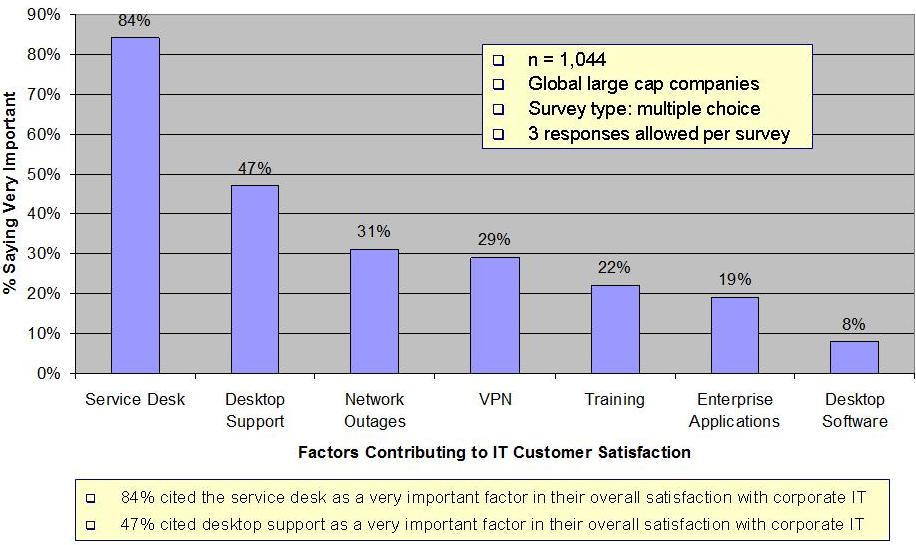
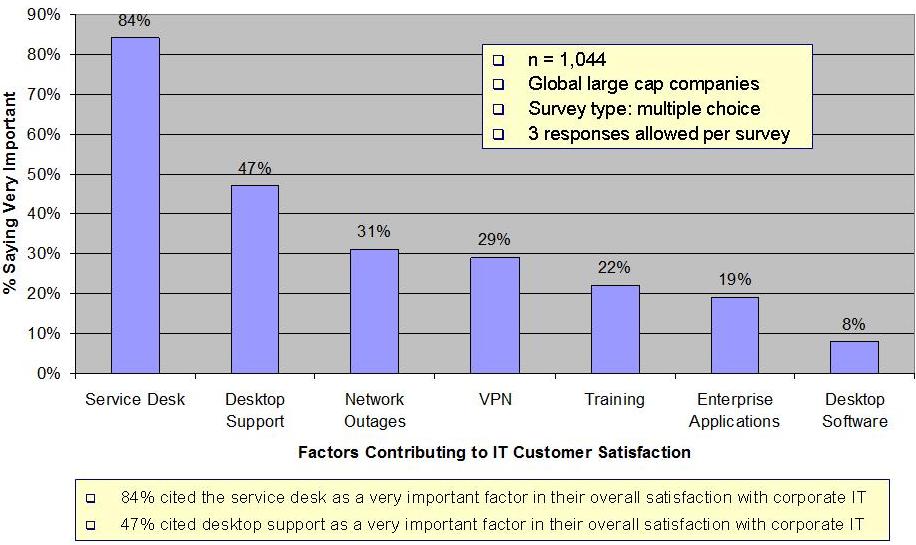
The first source of value is the impact of support on IT customer satisfaction. Please note that I am referring to customer satisfaction with
all of IT, not just with IT support. As figure 1 below illustrates, the vast majority of IT customer satisfaction is a direct result of interactions that customers have with support. This makes sense, as most end-users are exposed to IT primarily through the service desk and/or desktop support functions. The implication is that support represents a highly leveraged opportunity to shape user opinions about IT overall, and high customer satisfaction for support almost always translates into high customer satisfaction for all of IT.
Figure 1: Impact of Support on IT Customer Satisfaction
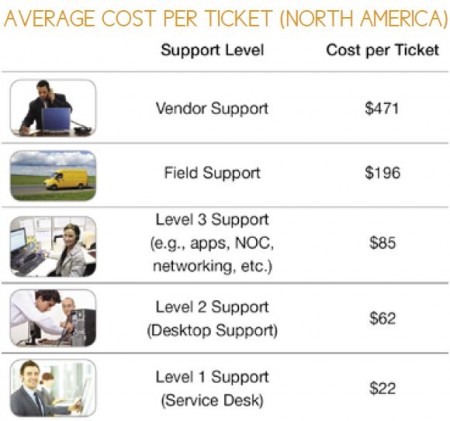
The second source of value derives from the power of support to minimize total cost of ownership (TCO). Last year the average cost per ticket was $22 for the service desk, $62 for desktop support, and $85 for level 3 IT support as shown in Figure 2 below. The unnecessary escalation of tickets to higher levels of support is a common problem in the industry. In fact, recent benchmarks show that 21% of all tickets resolved by desktop support could have, and should have been resolved by the level 1 service desk. These needless escalations result in increased support costs that are rarely tracked, and therefore go unnoticed. But by tracking escalation defects, support organizations with a business mindset ruthlessly track down and eliminate this source of inefficiency. It turns out that “Getting it done at level 1” is not just a pithy catchphrase…it can significantly reduce overall support costs!
Figure 2: Cost per Ticket – North American Averages
The third source of value is the economic benefit of enhanced user productivity. The majority of today’s workforce is comprised of knowledge workers, all of whom rely upon one or more computing devices to do their jobs. When these devices break down or do not function properly, worker productivity suffers. By preventing these incidents from occurring, and by quickly resolving issues when they do occur, a support organization can return productive hours to the workforce.
To measure just how significant this effect can be, MetricNet conducted a study in 2011 that concluded that the average knowledge worker loses about 33 hours of productive time per year due to various IT outages, breakdowns, hardware failures, software bugs, poor training, etc. That number, by itself, is significant. But what is more significant is how widely this number varies from one company to another, and the remarkable correlation that exists between the quality of end-user support and the number of productive hours lost.
For support groups that were in the top quartile for customer satisfaction, first contact resolution rate, and mean time to resolve, the average lost productivity per worker was 17 hours per year; about half the industry average. By contrast, companies that were in the bottom quartile for these metrics lost an average of 47 productive hours per worker per year. The difference between the best and the worst is a staggering 30 hours per employee per year! Put another way, organizations in the top quartile are able to return nearly four extra days of productivity annually for every knowledge worker in the enterprise. Multiply this by thousands or even tens of thousands of employees in a company, and the economic contribution of a top performing support group can be enormous.
The Zen Conclusion
Zen is about truth and enlightenment. In this article I have tried to shed light on some important, but often overlooked truths about IT support. I have outlined three character traits that any organization can adopt and cultivate, and three sources of value that any organization can leverage to their advantage. Most importantly, I have found that running support as a business is the defining characteristic of Zen-like support groups.
For all IT professionals I believe the implications of these insights are profound. For IT leadership, including CIO’s and CTO’s, I hope this article is a call to action, and prompts the necessary investment, not just in tools, training and headcount, but also in the time and attention that you devote to customer support. As I have shown, the reputation of your entire organization depends upon how well you manage this customer interface.
For support managers and supervisors I would ask you to adopt a business owner’s mindset. Among other things, this means that you compete aggressively for resources using business case analysis, you manage by the metrics and establish performance goals based on industry benchmarks, and you make it your personal mission to demonstrate value to key stakeholders on a daily basis.
Finally, for front-line support professionals, I know that it is easy to get overwhelmed by the day-to-day minutiae of service levels, performance goals, and customer complaints. I would ask you to step back from this ground-level perspective, and adopt a broader view of your role in the enterprise. You are the gateway to IT for the vast majority of users, and your performance drives not only the customer’s view of support, but indeed their satisfaction with all of IT. Use this opportunity wisely, for your actions are magnified many times over as they reverberate throughout the enterprise.