Membership is free and sign-up only takes a moment. Click the sign-up button below, complete the short form, and the full white paper — including every figure and a downloadable PDF — opens immediately.
How demonstrated AI experience is becoming a decisive source of advantage in enterprise IT support outsourcing.
A MetricNet White Paper by Jeff Rumburg, Co-founder & Managing Partner, MetricNet · 2026
Executive Summary
A new outsourcing dynamic is taking shape in enterprise IT support. For years, the decision to outsource the service desk or broader end-user support function was driven primarily by labor economics, access to scale, around-the-clock coverage, and the ability to convert fixed internal costs into a more flexible operating model. Artificial intelligence is now adding a more strategic reason to outsource: many managed service providers have accumulated substantially more practical experience deploying AI in support operations than the enterprises they serve.
Large enterprises are experimenting with copilots, conversational AI, virtual agents, voicebots, autonomous agents, retrieval-augmented knowledge, and AI-assisted workflow automation. Yet experimentation is not the same as production-scale adoption. Successful AI deployment requires integration with IT service management platforms, identity and access systems, knowledge repositories, monitoring tools, endpoint management, workflow engines, and human escalation processes. It also requires continuous tuning, governance, measurement, and user adoption.
For a single enterprise, the learning curve can be steep and the number of production implementations limited. An MSP, by contrast, can deploy similar capabilities across dozens or hundreds of clients. Each deployment creates reusable knowledge: which use cases work, which integrations are difficult, where hallucination or security risks arise, how users respond, how knowledge must be prepared, and which automation patterns produce measurable contact avoidance.
The result is an experience flywheel: the best AI-enabled MSPs learn faster because they implement more often. That learning can become a material advantage over an enterprise attempting the same transformation on its own.
01 A New Reason to Outsource
The traditional outsourcing proposition has been straightforward. Providers aggregate labor, process expertise, tools, and management across multiple clients. Offshore and nearshore delivery centers can lower unit labor costs, while standardized operating models can improve coverage and scalability. Those advantages remain important, but they no longer tell the whole story.
Want this measured continuously rather than once a year? Try Artevys
How demonstrated AI experience is becoming a decisive source of advantage in enterprise IT support outsourcing.
A MetricNet White Paper by Jeff Rumburg, Co-founder & Managing Partner, MetricNet · 2026
Executive Summary
A new outsourcing dynamic is taking shape in enterprise IT support. For years, the decision to outsource the service desk or broader end-user support function was driven primarily by labor economics, access to scale, around-the-clock coverage, and the ability to convert fixed internal costs into a more flexible operating model. Artificial intelligence is now adding a more strategic reason to outsource: many managed service providers have accumulated substantially more practical experience deploying AI in support operations than the enterprises they serve.
Large enterprises are experimenting with copilots, conversational AI, virtual agents, voicebots, autonomous agents, retrieval-augmented knowledge, and AI-assisted workflow automation. Yet experimentation is not the same as production-scale adoption. Successful AI deployment requires integration with IT service management platforms, identity and access systems, knowledge repositories, monitoring tools, endpoint management, workflow engines, and human escalation processes. It also requires continuous tuning, governance, measurement, and user adoption.
For a single enterprise, the learning curve can be steep and the number of production implementations limited. An MSP, by contrast, can deploy similar capabilities across dozens or hundreds of clients. Each deployment creates reusable knowledge: which use cases work, which integrations are difficult, where hallucination or security risks arise, how users respond, how knowledge must be prepared, and which automation patterns produce measurable contact avoidance.
The result is an experience flywheel: the best AI-enabled MSPs learn faster because they implement more often. That learning can become a material advantage over an enterprise attempting the same transformation on its own.
01 A New Reason to Outsource
The traditional outsourcing proposition has been straightforward. Providers aggregate labor, process expertise, tools, and management across multiple clients. Offshore and nearshore delivery centers can lower unit labor costs, while standardized operating models can improve coverage and scalability. Those advantages remain important, but they no longer tell the whole story.
AI is changing the source of provider advantage. Increasingly, the question is not merely whether an outsourcer can answer support contacts at a lower cost. It is whether the provider can prevent a meaningful share of those contacts from ever reaching a human agent.
This changes the strategic calculus. An enterprise may have an excellent internal service desk but relatively little experience integrating AI into the support ecosystem. A mature MSP may have already confronted the same implementation questions repeatedly across its client base. Where that experience has produced demonstrable results, outsourcing can accelerate AI adoption rather than simply reduce labor cost.
02 Why Enterprise AI Adoption Is Harder Than It Looks
The market is crowded with impressive demonstrations. A chatbot can answer a password question. A copilot can summarize a ticket. An autonomous agent can classify an incident or suggest a resolution. But production support environments are considerably more demanding than demonstrations.
To produce durable business value, AI must operate inside a complex service delivery system. Typical requirements include:
Integration with ITSM platforms so AI can create, update, route, resolve, and document incidents and requests.
Access to trusted enterprise knowledge with permissions, version control, content hygiene, and retrieval quality sufficient for production use.
Secure identity and entitlement checks before an automated system takes actions on behalf of an employee.
Integration with endpoint, monitoring, collaboration, and workflow platforms so the AI can do more than merely answer questions.
Clear handoffs to human agents when confidence is low, risk is elevated, or the user simply prefers human assistance.
Governance, logging, quality assurance, privacy controls, and measurement that satisfy enterprise risk requirements.
Change management that persuades employees to use AI channels rather than bypass them and contact the service desk directly.
These are not one-time implementation tasks. Models change, knowledge changes, applications change, and employee behavior changes. AI-enabled support therefore becomes an operating capability that must be continuously managed.
03 The MSP Experience Flywheel
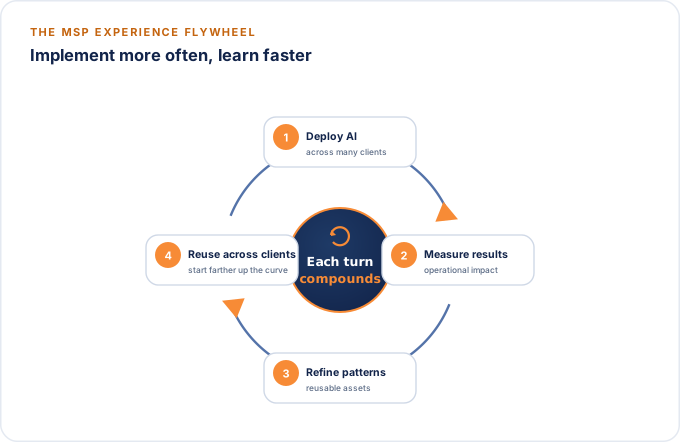
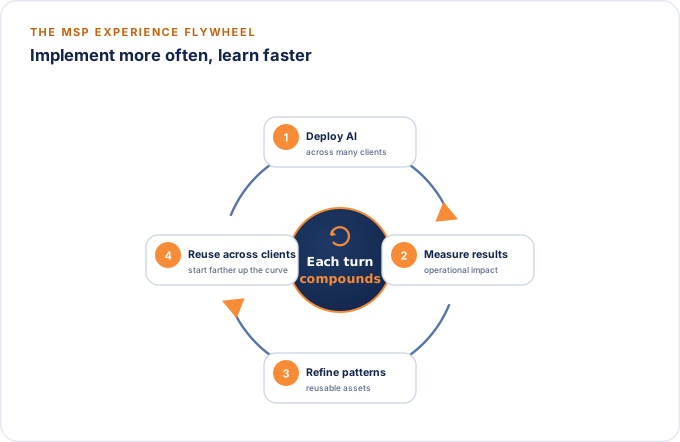
This is where scale can create an asymmetry. An enterprise typically has one environment and one transformation journey. An MSP can accumulate learning across many environments. The provider that deploys virtual agents for 30 clients, copilots for 50 clients, and automated fulfillment workflows for 20 clients is exposed to a much larger set of implementation patterns than any one customer.
Figure 1. The MSP AI experience flywheel. Each deployment produces reusable assets — integration patterns, governance frameworks, adoption playbooks, and benchmark data — so the next engagement begins farther up the learning curve.
Over time, reusable assets emerge: prompt and orchestration patterns, integration connectors, governance frameworks, knowledge-preparation methods, escalation logic, adoption playbooks, and benchmark data. The strongest providers can therefore begin a new engagement farther up the learning curve.
This does not mean every MSP possesses such an advantage. It means the providers that have genuinely implemented AI at scale can possess an advantage that is difficult for a single enterprise to replicate quickly.
04 Contact Deflection Becomes the Proof Point
The most persuasive evidence of AI maturity is not the number of AI products in a provider's portfolio or the number of demos it can conduct. It is measurable operational impact. In IT support, one of the clearest measures is the percentage of demand that is successfully resolved or fulfilled through AI-enabled channels without requiring a live service desk interaction.
This can include conversational self-service, automated troubleshooting, password and access workflows, software fulfillment, knowledge-guided resolution, proactive remediation, and AI-assisted transactions completed inside collaboration tools or digital employee experience platforms.
Benchmarking Data Proves the Point
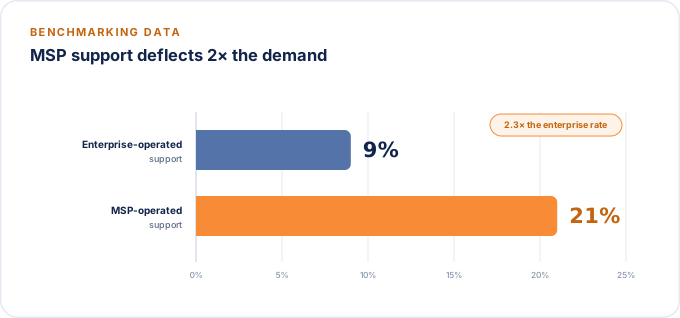
MetricNet benchmarking data shows a substantial gap in AI-enabled contact deflection between internally operated enterprise support organizations and MSP-operated environments. Enterprises currently average 9% AI deflection, compared with 21% for MSPs — more than twice the enterprise rate.
Figure 2. Average AI-enabled contact deflection: enterprises vs. MSPs. Source: MetricNet benchmarking data. AI deflection = support demand resolved or fulfilled through AI-enabled channels without a live service desk interaction.
The comparison supports the central thesis of this paper: implementation experience matters. MSPs that deploy AI repeatedly across multiple client environments can accumulate integration patterns, governance practices, knowledge-management discipline, adoption techniques, and automation experience faster than a single enterprise implementing AI largely on its own.
A provider that can demonstrate sustained, audited contact deflection across comparable client environments has a much stronger claim to AI leadership than one that merely reports chatbot usage, license counts, or gross automation activity.
05 The Market Is Beginning to Reward Demonstrated AI Capability
This emerging capability gap helps explain why some large enterprises are reconsidering the boundary between internal and outsourced support. An organization sitting on the sidelines of AI adoption may conclude that building the capability internally will require years of experimentation, specialized talent, and repeated integration work. A provider that has already solved many of those problems can offer a faster path.
In many cases, offshore delivery remains part of the model, but the rationale is evolving. The old proposition was: move work to a lower-cost labor pool. The new proposition can be: move support to a provider that combines a global delivery model with proven AI-enabled demand reduction.
The strategic value of outsourcing rises when the provider can both lower the cost of human support and reduce the amount of human support required.
06 But Not All MSPs Are Created Equal
The rapid growth of AI marketing has created a predictable problem: nearly every major provider now claims significant AI capability. Buyers should assume that some claims are stronger than others.
A common source of confusion is the way "deflection" is defined. A provider may count a user who opens a chatbot as a deflected contact even if that user subsequently calls the service desk. It may count search activity, suggested answers, abandoned sessions, or tickets avoided for reasons unrelated to AI. In other cases, the denominator may be selected so narrowly that the reported percentage appears far more impressive than the enterprise-wide impact.
Buyers should therefore distinguish between AI activity and verified AI outcomes. A credible claim should explain what demand was eligible for automation, what percentage entered an AI channel, what percentage was resolved without human intervention, what percentage later generated a human contact, and how the result was independently validated.
07 A Practical Due-Diligence Framework
Enterprises evaluating an AI-enabled MSP should press beyond the sales presentation. At minimum, they should ask for evidence in six areas:
Figure 3. Press beyond the sales presentation: a credible AI-enabled MSP can produce evidence in each of these six areas.
Production scale. How many enterprise clients are live in production with the proposed AI capabilities, and for how long?
Comparable outcomes. What measurable reduction in human-assisted contacts has been achieved for clients of similar size, complexity, geography, and technology?
Definition integrity. Exactly how are containment, deflection, autonomous resolution, and assisted resolution defined?
Integration depth. Which ITSM, identity, endpoint, knowledge, monitoring, collaboration, and workflow systems are integrated in production?
Governance & risk. How are permissions, hallucinations, sensitive data, auditability, model changes, and human escalation controlled?
Commercial alignment. Does the pricing model reward the provider for eliminating demand — or for maintaining large numbers of support FTEs?
08 The Pricing Model Must Evolve Too
There is an inherent tension between AI-driven demand reduction and traditional FTE-based outsourcing. If a provider is paid primarily for the number of people assigned to an account, successful automation can reduce its revenue. That creates the wrong incentive.
AI-enabled outsourcing is therefore likely to accelerate the move toward commercial models based on outcomes, transactions, experience levels, resolved demand, or shared productivity gains. The exact model will vary, but the principle is important: the customer and provider should both benefit when AI eliminates avoidable work.
This does not imply that human support disappears. Complex incidents, emotionally charged interactions, ambiguous requests, executive support, security-sensitive situations, and novel failures will continue to require people. The human service desk increasingly becomes the exception-handling layer for demand that automation cannot or should not resolve.
09 What This Means for Enterprise Leaders
The outsourcing decision should no longer be framed as a binary choice between internal control and lower-cost external labor. AI introduces a third variable: implementation experience. An enterprise should compare its own ability to deploy and continuously improve AI-enabled support with the demonstrated capabilities of potential providers.
For organizations that already possess strong internal AI engineering, clean knowledge, mature ITSM integration, and a successful automation program, outsourcing may offer less incremental AI advantage. For organizations that have struggled to move beyond pilots, however, a proven MSP can provide access to experience that would be expensive and time-consuming to build internally.
The decision should be evidence-based. Outsourcing merely because a provider uses the words "agentic AI" is not a strategy. Outsourcing to a provider that can show repeatable, independently measurable reductions in human-assisted demand may be.
10 Conclusion: AI Experience Is Becoming a Source of Outsourcing Advantage
The next chapter of IT support outsourcing will not be defined solely by wage arbitrage or labor scale. It will increasingly be defined by who can operationalize AI most effectively.
The strongest MSPs are developing a critical mass of implementation experience across copilots, virtual agents, voicebots, autonomous agents, knowledge systems, and workflow automation. Because they can apply lessons across multiple clients, they have the potential to move faster than enterprises that are learning one implementation at a time.
That advantage is already creating a compelling new reason for some enterprises to outsource IT support: not because they have given up on technology transformation, but because they want to accelerate it.
The caveat is equally important. AI claims must be tested, definitions must be scrutinized, and outcomes must be verified. The market will ultimately separate providers that merely market AI from those that have demonstrated the ability to remove meaningful volumes of avoidable support demand.
The winners in the next generation of IT support outsourcing will not be the providers with the largest service desks. They will be the providers that can prove they need fewer human interactions because their AI actually works.
About the Author
Jeff Rumburg — Co-founder & Managing Partner, MetricNet
Jeff Rumburg is a co-founder and Managing Partner of MetricNet, where he is responsible for global strategy, product development, and financial operations. A leading expert in benchmarking and re-engineering, he has been retained as a benchmarking and service-and-support expert by many of the world's best-known companies and was honored with the Ron Muns Lifetime Achievement Award for his contributions to the IT Service and Support industry.
Prior to co-founding MetricNet, Rumburg was president and founder of The Verity Group and held executive positions at Gartner and META Group. His education includes an M.B.A. from Harvard Business School, an M.S. magna cum laude in Operations Research from Stanford University, and a B.S. magna cum laude in Mechanical Engineering. He is the author of A Hands-On Guide to Competitive Benchmarking: The Path to Continuous Quality and Productivity Improvement and has taught graduate-level engineering and business courses.